
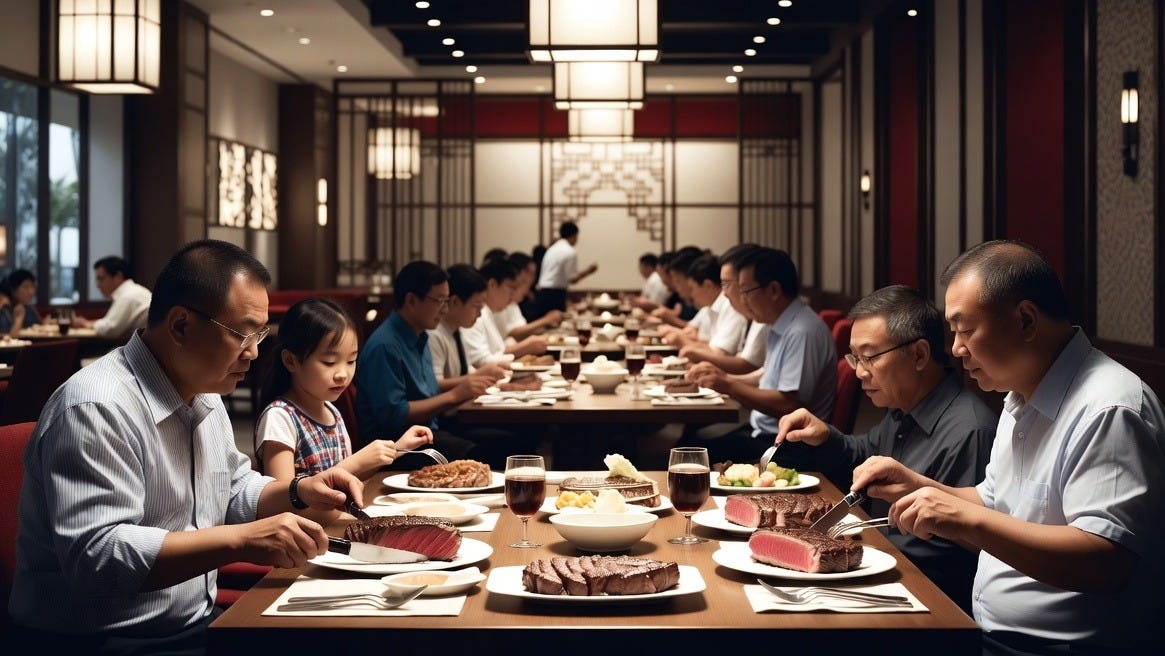
For years we’ve been told a pretty simple story about meat.
Eat more red meat and you’re probably shortening your life.
Eat less of it, especially as you get older, and you’re probably doing yourself a favor.
I’m not convinced it’s that simple.
Now before somebody starts sharpening their vegan pitchfork, I’m not here to tell you everybody should eat like I do.
Peggy certainly doesn’t.
I eat what I’d call carnivore-ish these days. Lots of meat and eggs, very few carbohydrates, very little processed food.
Peggy is pescatarian.
We eat differently.
We’re both doing pretty darn well.
And that alone has made me increasingly suspicious of anybody who tells me they’ve discovered the one diet everybody should follow.
An Interesting Problem With the Meat Story
A few years ago, researchers looked at meat consumption and life expectancy across 175 countries.
They found something that doesn’t fit very neatly into the usual story.
Countries that consumed more meat tended to have longer life expectancy.
That doesn’t prove meat caused people to live longer. This kind of population study can’t do that. Wealthier countries may eat more meat while also having better sanitation, healthcare, education, housing, and a hundred other things that affect lifespan.
But it does raise a reasonable question.
If eating meat were as straightforwardly disastrous as it’s sometimes portrayed, wouldn’t we expect that to show up more clearly?
That’s where I think things get interesting.
Another Study Looked at More Than 134,000 People
The PURE study followed people from 21 countries for a median of about 9½ years.
Researchers looked separately at unprocessed red meat, poultry, and processed meat.
Higher consumption of unprocessed red meat wasn’t significantly associated with total mortality or major cardiovascular disease in that study.
Processed meat was a different story.
That distinction matters to me.
A steak and a highly processed meat product aren’t necessarily the same nutritional question, just as an apple and an apple-flavored toaster pastry aren’t the same thing because both contain carbohydrates.
Food gets complicated when we insist on putting enormous categories into one bucket.
Then Things Got Even More Interesting
A newer study followed more than 5,000 Chinese adults who were already 80 or older.
Researchers wanted to know who would make it to 100.
Overall, vegetarians had lower odds of becoming centenarians than omnivores. Vegans did too.
But here’s the part worth paying attention to.
The difference was most apparent among people who were underweight. Among people who weren’t underweight, the association wasn’t statistically significant.
That’s considerably more interesting than screaming:
MEAT MAKES YOU LIVE TO 100!
It doesn’t prove that.
What it does suggest is that nutrition late in life may be more complicated than simply removing animal foods.
And frankly, that makes sense to me.
As we get older, maintaining muscle, strength, bone, and enough good nutrition becomes increasingly important. What worked for somebody at 35 may not be the whole story at 85.
So What Should You Eat?
Ah, there’s the question everybody wants answered.
I don’t know.
Sorry. 😂
I know what works very well for me.
Nineteen years ago I had type 2 diabetes and weighed 98 pounds more than I do today. Changing how I ate was a huge part of changing my life.
Over the years my eating has continued to evolve. Today I eat mostly animal foods, keep carbohydrates low, avoid most ultra-processed food, and eat when I’m hungry rather than because the clock says noon.
I feel good.
My weight has been stable for years.
I have plenty of energy to teach and move six days a week at 72.
That’s my experience.
It isn’t a randomized clinical trial.
And Peggy is sitting right beside me proving that you don’t have to eat exactly like Dave Stevens to thrive. 😂
Maybe We’re Asking the Wrong Question
I don’t think the useful question is:
Is meat good or bad?
That’s too easy.
Maybe better questions are:
Are you getting enough protein?
Are you maintaining muscle as you get older?
Are you eating mostly actual food?
How do you feel?
How is your body responding?
Can you sustain the way you’re eating without turning every meal into a chemistry experiment?
And perhaps most importantly:
Is it helping you live the life you want to live?
I’m personally convinced animal foods are extraordinarily nutritious. I’m going to keep eating them.
You don’t have to agree with me.
What I would like you to do is stay curious.
Don’t join a dietary religion because somebody on the internet has impressive abs and a microphone.
Pay attention to the research.
Pay attention to your own body.
Eat real food.
Stay strong.
And keep adjusting as you learn.
That’s a lot less exciting than declaring steak either a superfood or attempted murder.
But I suspect it’s closer to the truth.
I truly understand this. For 2 years we have been eating keto/carnivore/ketovore. Weight loss, lower blood sugars (me), stable kidney disease (him), feel great. Prior to my diagnosis we had been on Mediterranean diet that included grains, legumes, root veg. We now eat meat and/or eggs at every meal. Pastured when we can get it. This information is spreading, yet acceptance is low.