
I want you to pay attention to your hands this week. Not measure them. Not grade them. Just notice what they can still do.
Can you open the jars in your kitchen? Carry grocery bags from the car? Work comfortably with your garden tools? Wring out a wet towel? Pick up something heavy without worrying that it might slip?
And here’s the more important question:
Has any of that quietly changed?
Peggy and I talk about grip quite a bit in our classes. It may seem like a little thing. I’m not sure it is.
Peggy Hears It From Students
Over the years, people have come back and told Peggy about changes they’ve noticed. Gardening is easier. Opening jars is easier. Carrying things is easier.
Little stuff.
Except as we get older, you begin to realize the little stuff isn’t little at all. Opening your own jar means independence. Working in your garden means doing something you love. Being able to hold onto something when you need to means your hands are still participating in your life.
And your grip isn’t working all by itself. Your hands, arms, shoulders, back and nervous system are all part of the job.
That’s one reason grip strength has attracted so much attention from researchers. A large 2015 study followed nearly 140,000 adults in 21 countries and found that weaker grip strength was associated with higher mortality and cardiovascular risk. In that study, grip strength was actually a stronger predictor of death than systolic blood pressure.
That’s fascinating. But I don’t want you squeezing a ball this week because you’re afraid of dying.
What a lousy reason to squeeze a ball. 😂
I want you to care about your grip because you use it.
Your Life Is Already Giving You a Test
You can buy a dynamometer if you want a number. That’s the little device researchers use to measure grip strength.
But before you buy anything, look around. Your life is already giving you information.
Maybe the pickle jar has become harder to open. Maybe you use two hands for something you once carried with one. Maybe your hands tire more quickly in the garden. Maybe grocery bags feel heavier. Maybe you’ve stopped hanging from things altogether.
We adjust to these changes remarkably well. That’s part of the problem. We use two hands. We buy the easier-opening container. We carry a little less. We stop doing the thing that became difficult.
Life goes on, and pretty soon the adjustment becomes normal.
I’d rather notice.
Not because every change means something terrible is happening. Because once you notice something, you have the opportunity to decide whether you want to do something about it.
Go Hang Around
One of Peggy’s and my favorite ways to give our hands some work is wonderfully complicated.
Hang.
That’s it. Give me a good sturdy bar and I’m happy. Put Peggy and me near playground monkey bars and there’s a decent chance we’re going to play on them.
Somewhere along the road, adults apparently decided playgrounds belonged exclusively to children. Who made that rule?
If you have access to a secure bar and hanging is appropriate for you, grab it. That does not mean you need to dangle your entire body weight from your fingertips tomorrow morning.
Keep your feet supported if that’s what works for you. Let your hands take some of the load. See how it feels.
Your hands work. Your arms work. Your shoulders get involved. Your body has to organize itself around what you’re asking it to do.
And you might accidentally have fun.
Terrible side effect.
Or Just Squeeze Something
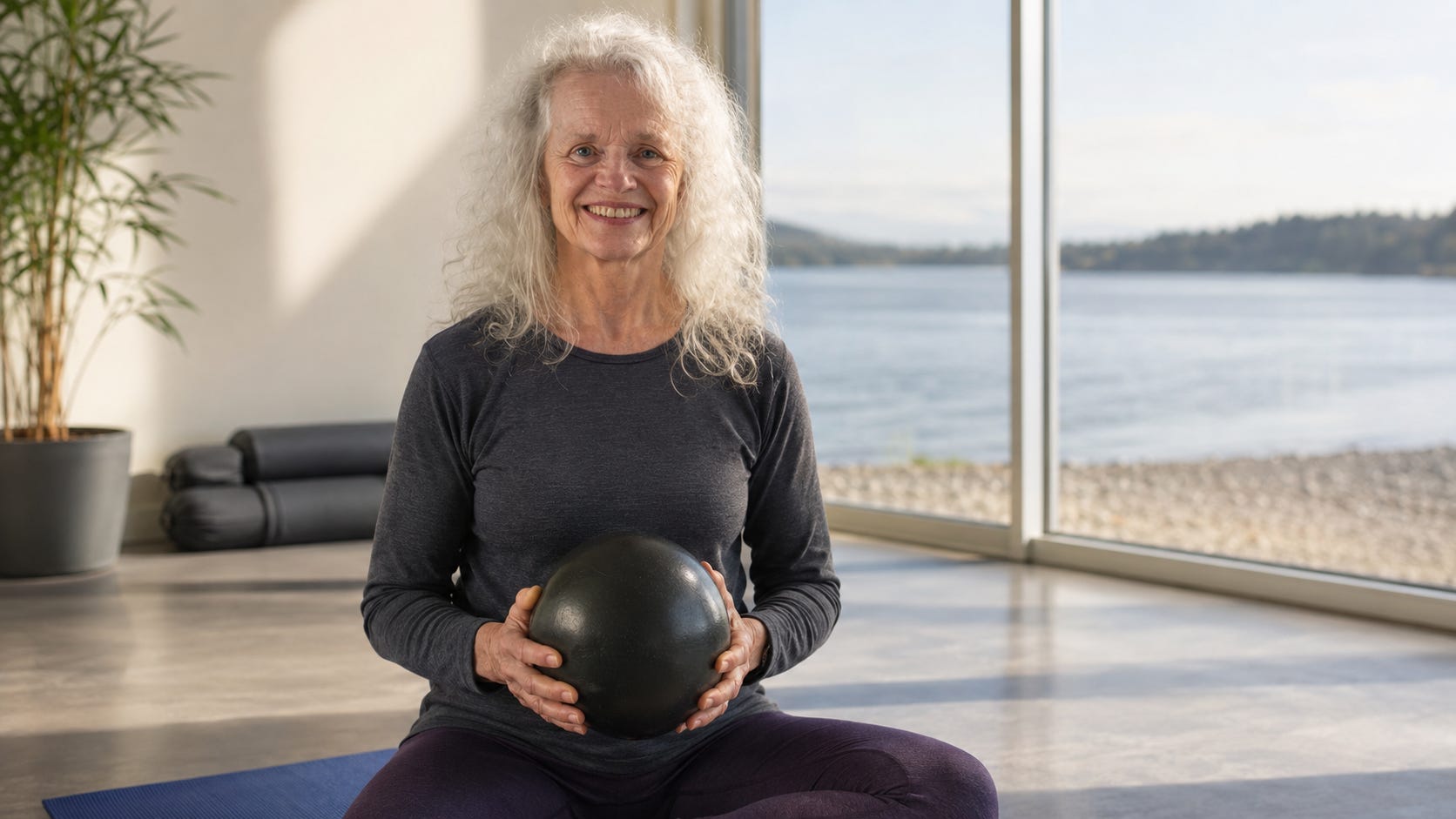
Peggy often has students squeeze a Coregeous ball. Nothing fancy. A soft ball with some resistance can give your hands something to do too.
Squeeze. Release. Use your fingers. Use your whole hand. You don’t need fifty repetitions or a complicated schedule.
Give your hands a reason to work.
And don’t forget all the ordinary opportunities already sitting around you. Carry something. Garden. Pick things up. Move things. Twist things. Use your hands for more than tapping a screen.
That’s one of the ideas Peggy and I come back to over and over.
Your body needs to know you still expect something from it.
Build Before You Need It
There’s another reason this matters so much to me.
Peggy.
When she went through chemotherapy, she continued teaching through four rounds. I believe deeply that all those years of movement before cancer mattered.
She didn’t begin that experience from zero. She went into it after years and years of moving, stretching, strengthening, teaching and using her body.
She had prepared for a challenge she never knew was coming.
We don’t know what life is going to ask of us next. Maybe it’ll be something hard. Maybe it’ll be something wonderful.
A trip. A new grandchild. A garden you want to keep tending. A trail you didn’t know you’d want to walk. A dog that suddenly decides the squirrel across the street represents an immediate threat to national security.
Whatever comes, I’d rather meet it with some capacity in reserve.
That’s how I think about strength these days. Not bigger numbers for the sake of bigger numbers.
Capacity for whatever comes next.
One Thing This Week
So here’s all I’d like you to do. Pay attention to your hands.
If everything feels good, wonderful. Keep using them. If you notice something has become a little harder, get curious.
And then give your hands something to do.
Squeeze a ball for a little while. Carry the groceries. Spend some time in the garden. Grab a secure bar with your feet supported and see how it feels.
Pick one.
We’re not starting the Move Well Stay Healthy International Grip Strength Olympics. 😂
We’re simply paying attention to one part of your body that’s very easy to take for granted until it stops doing something you need.
And if you notice something this week, I’d love to hear about it. Maybe it’s something you’ve lost. Even better, maybe it’s something you’ve realized you can still do.
Because this isn’t really about grip strength. It’s about something I want every one of us to keep discovering:
There are things we can do today that may help us remain capable tomorrow.
That’s worth holding onto.