
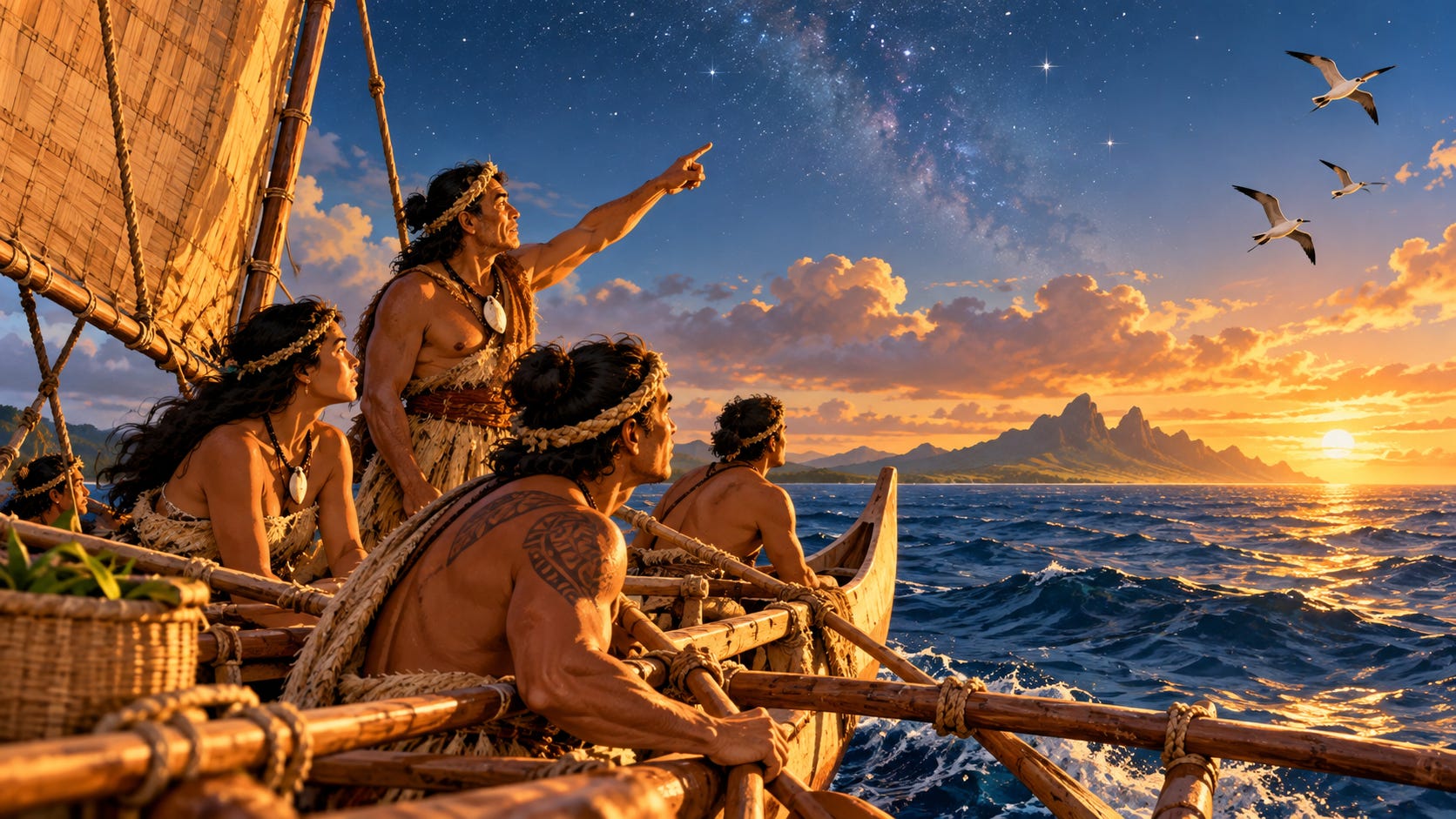
Imagine climbing into a wooden canoe, pushing away from shore, and heading out into the Pacific Ocean.
Not for an afternoon.
You’re going hundreds, perhaps thousands, of miles.
No GPS. No compass. No engine. No radio.
Just you, your companions, a canoe, and an awful lot of water.
And somehow, Polynesian sailors were doing this hundreds of years before Columbus crossed the Atlantic.
I find that absolutely astonishing.
These weren’t people drifting around hoping to bump into an island.
They knew how to navigate.
They studied the stars, watched the winds, recognized patterns in ocean swells, and paid attention to birds that might indicate land beyond the horizon.
Think about that for a moment.
You’re surrounded by water. Nothing but ocean in every direction.
And somebody aboard your canoe notices a subtle change in the movement of the waves.
That means something.
Or a particular bird flies overhead late in the afternoon.
That means something, too.
Knowledge passed down through generations, refined by people who spent their lives learning to understand the ocean.
And now, modern genetics is adding another piece to this remarkable story.
An October 2026 study involving more than a thousand people with Polynesian ancestry found an especially close genetic relationship between populations in Hawaiʻi and Rapa Nui, also known as Easter Island.
Those islands are separated by roughly 4,400 miles of ocean.
The researchers also identified ancestral connections involving Mangareva in French Polynesia.
That doesn’t prove a particular canoe traveled directly between Hawaiʻi and Rapa Nui. Shared ancestry doesn’t tell us the exact routes people followed.
But it adds to the evidence of just how extraordinary Polynesian exploration really was.
And here’s something else I love.
In 1976, the voyaging canoe Hōkūleʻa sailed from Hawaiʻi to Tahiti using traditional navigation methods, guided by master navigator Mau Piailug.
No modern navigation instruments.
They made it.
I keep thinking about those ancient sailors.
Somebody steering. Somebody watching the stars. Somebody recognizing a change in the swells.
And somewhere beyond the horizon, an island.
I’d love to spend an afternoon talking with one of those navigators.
Although I suspect I’d spend most of it asking questions and feeling like the dumbest guy in the canoe.