
Can you get out of a chair without struggling?
Carry your groceries?
Climb a flight of stairs?
Get down on the floor and, rather importantly, get back up again?
Can you catch yourself when you stumble?
Those questions interest me a lot more at 72 than how much somebody can bench press.
Not because there’s anything wrong with bench pressing.
But because the older I get, the more I appreciate a different kind of strength.
The strength that lets you keep living your own life.
Your Legs Matter
There’s actually some fascinating research around something as ordinary as standing up from a chair.
Researchers use repeated chair-stand tests to measure lower-body function. You sit in a chair, stand up and sit back down several times, usually without using your arms.
Simple.
But performance on tests like this has been associated with mortality risk in older adults. A recent study of more than 43,000 adults over 50 found that both chair-stand performance and grip strength were associated with mortality over about seven years.
That doesn’t mean standing up from a chair five times will make you live longer.
That’s not how this works.
It means something much more useful.
Your ability to do ordinary physical things tells us something about your overall health and capacity.
And I think we sometimes overlook that because it isn’t very sexy.
Nobody is selling tickets to the World Chair-Standing Championships.
Then There’s Your Grip
This one surprised me when I first started reading the research.
Grip strength has repeatedly been associated with health outcomes and mortality.
One large international study found that for every 5-kilogram decrease in grip strength, the risk of death during follow-up was about 16 percent higher.
A later meta-analysis involving more than 3 million people found essentially the same association.
Again, that does not mean squeezing one of those little grip trainers while watching television is the secret to immortality.
Grip strength is probably telling us something broader about the person.
Strength.
Muscle.
Activity.
Health.
Capacity.
That’s why I find it interesting.
I Care About What Strength Lets Me Do
At 72, I can get off the floor easily.
I climb stairs without thinking about it.
I carry things.
I walk.
I teach movement classes six days a week.
I don’t say that because I think I’ve defeated aging.
I haven’t.
I’m aging every day, same as everybody else.
What I care about is maintaining as much capacity as I can while I do it.
That’s a big part of what Peggy and I have spent years working on at RiversZen.
Not building impressive-looking muscles.
Building useful bodies.
Legs strong enough to stand.
Hips strong enough to move you.
A torso that helps you stay stable.
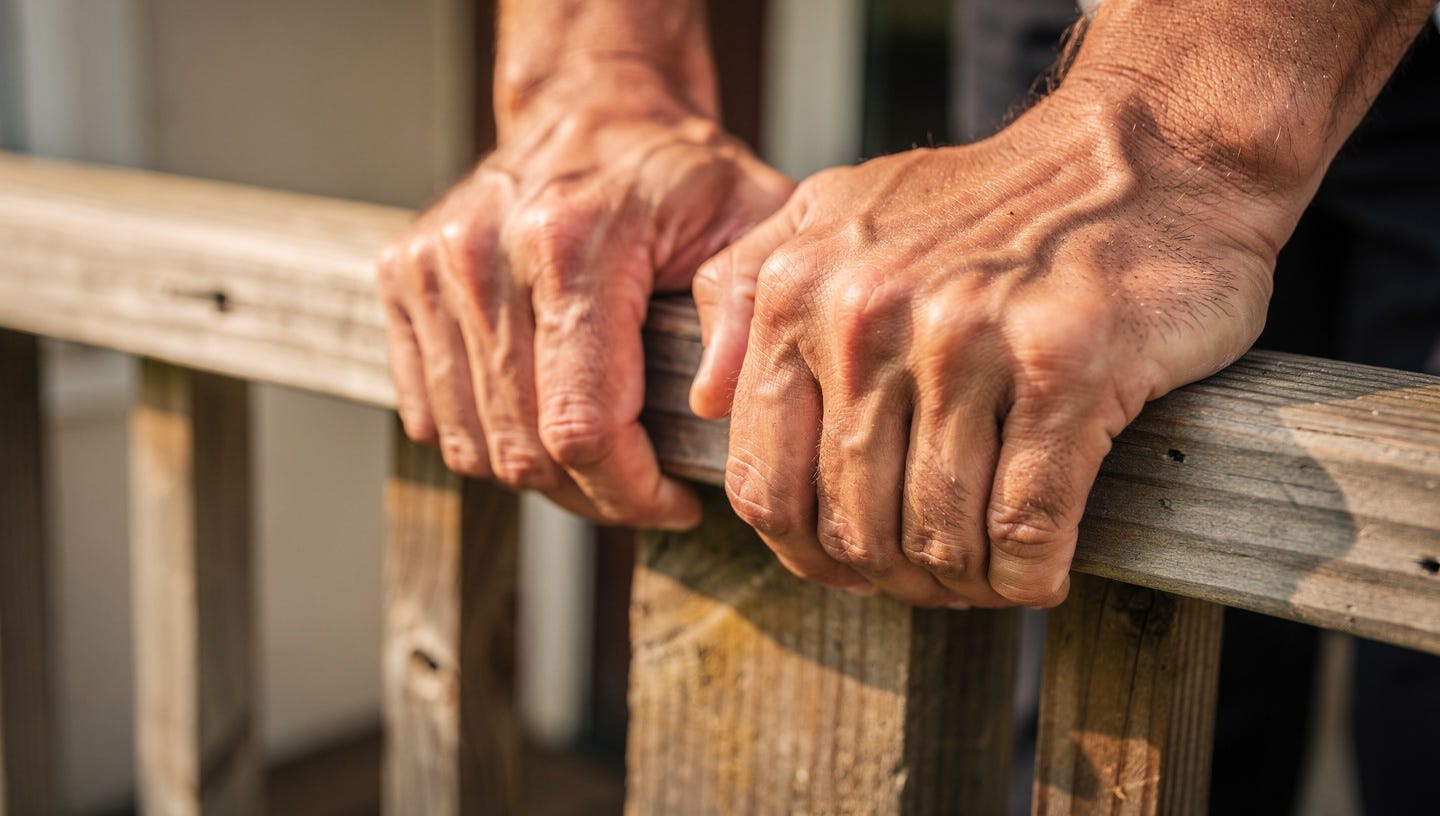
Hands strong enough to carry and hold things.
Balance good enough to recover when the sidewalk decides to get interesting.
None of this requires you to become a gym rat.
Don’t Train Muscles. Train Your Life.
This is probably the biggest change I’d make to the way we think about strength as we get older.
Instead of asking:
What muscles should I strengthen?
Try asking:
What do I want to keep being able to do?
Get off the floor?
Garden?
Travel?
Carry your suitcase?
Play with the grandkids?
Walk trails?
Live independently?
Good.
Those are your reasons to stay strong.
Then use whatever kind of movement you’ll actually continue doing.
Resistance training is great.
We use Contracted Stretching.
We walk.
We practice getting down and back up.
We move in ways that challenge balance, mobility and strength together.
There isn’t one magic program.
There is, however, a pretty lousy program:
Stop using your body.
So here’s something you can do today.
Sit in a sturdy chair.
Without using your hands if that’s safe and comfortable for you, stand up.
Sit back down.
Notice how it feels.
Don’t turn it into a test you have to pass.
Just pay attention.
Because someday the ability to stand up from that chair may matter considerably more than what the scale says.
Build strength for the life you want to keep living.
That’s the muscle group I’m interested in.