
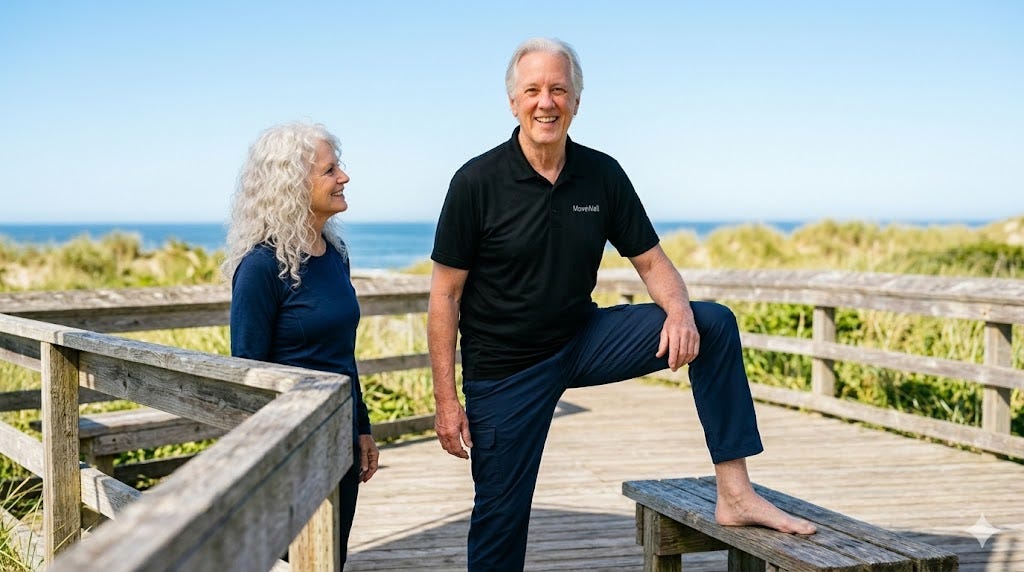
For years I thought stretching meant what most people think it means.
Find something tight. Pull on it. Hold it for thirty seconds. Hope it gets looser.
I did plenty of that.
And like a lot of people, I discovered something frustrating.
The tightness kept coming back.
That eventually led Peggy and me to resistance stretching, and it completely changed the way I thought about flexibility.
Instead of relaxing a muscle and pulling on it, you contract the muscle while you’re stretching it.
You’re strengthening and lengthening at the same time.
That sounds like a small difference.
For me, it wasn’t.
When I started doing this in 2007, I was facing a collection of possible surgeries involving my feet, knee, back, shoulder and hip. My body hurt in enough places that keeping track of them was becoming a hobby.
Contracted Stretching became a huge part of changing that.
Peggy and I eventually trained extensively in resistance stretching, and we’ve now spent years using and adapting what we learned with ourselves and thousands of sessions with other people.
And one thing has become very clear to me:
Strength and flexibility belong together.
I don’t just want to be able to pull my leg farther.
I want my body to be strong in that range.
That’s an important distinction.
Your nervous system absolutely plays a role in how muscles respond to stretching. There are protective reflexes involved. But after all these years, I don’t spend much time thinking about whether I’m “overriding” anything.
I’m paying attention to something much simpler.
Can I control the movement?
Can I create resistance?
Can I move through the range while the muscle is actually working?
And afterward, does my body move better?
That’s the test I care about.
I still use other kinds of stretching. Yoga has been part of my life for years. Sometimes simply reaching, moving and holding a position feels wonderful.
No stretching police are coming to confiscate your yoga mat. 😄
But if you’ve been pulling on the same tight hamstrings for years and they’re still tight every morning, maybe it’s worth trying something different.
Something to Think About
The next time you stretch, don’t only ask:
How far can I go?
Ask:
How strong and controlled am I here?
That question changed the way I stretch.
It eventually changed a whole lot more than that.