
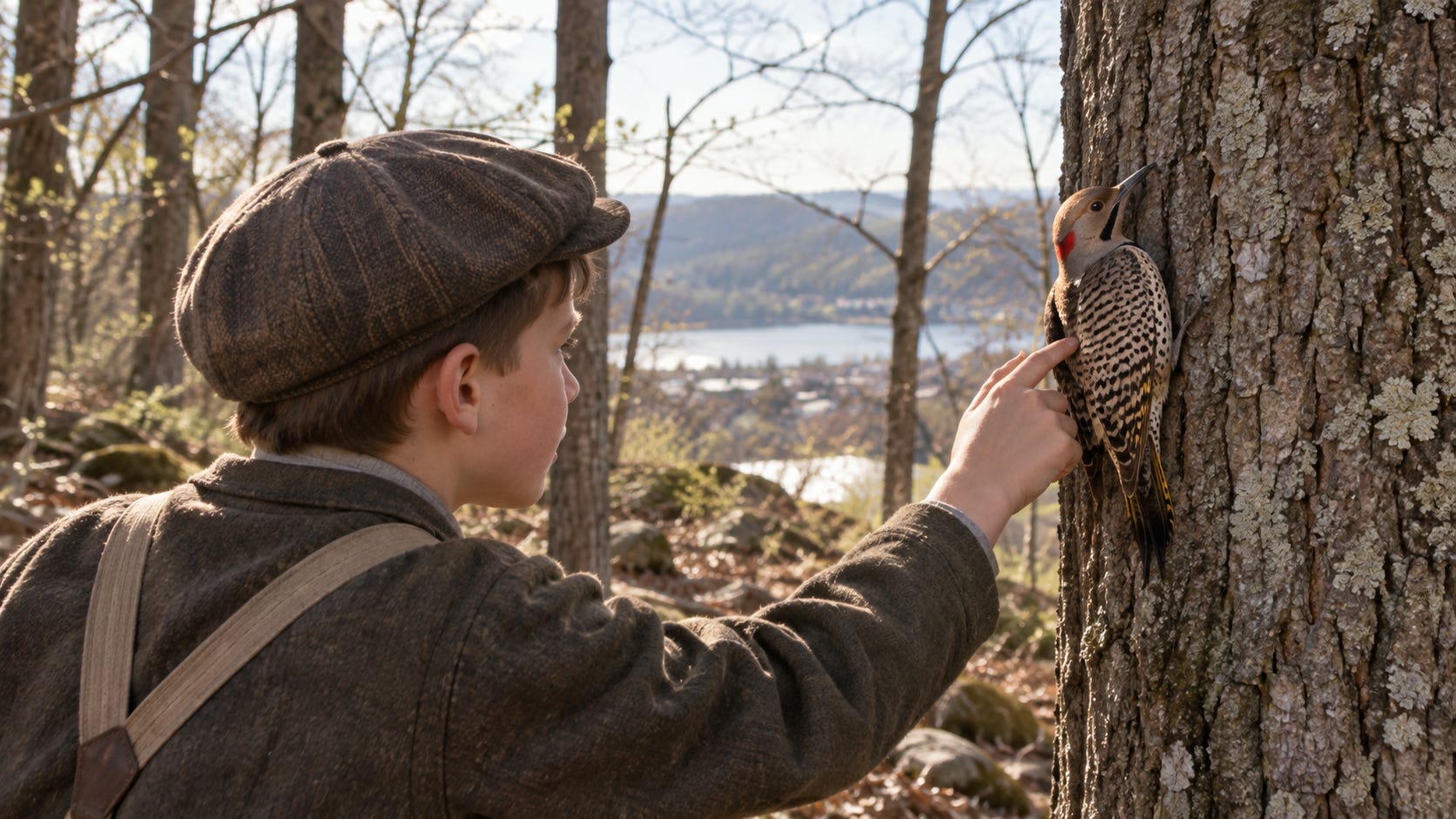
April 8, 1920. Roger Tory Peterson was 11 years old, wandering through a woodlot on Swede Hill outside Jamestown, New York. He found a bundle of brown feathers clinging to the trunk of a tree. A flicker. It looked dead.
Peterson reached out and touched its back. The head snapped around.
I love that part.
For a second it was just the two of them. An 11-year-old boy staring at a bird he had already buried in his mind, and a very much alive flicker staring back at the kid who had just poked it. Then the bird opened its wings, flashed gold, and disappeared.
I wonder how long Peterson stood there.
From then on, he said, birds seemed to him an extraordinary expression of life. He kept looking. The field guides came much later. Millions of people carrying his books around, learning the names of the birds outside their own windows.
But none of that existed yet. There was just a boy, a tree, and a bird that wasn’t dead.
A hundred years later, apparently we have a name for what happened to him. Spark bird.
It’s the bird that does it. Or sometimes the person who shows you the bird. Or the book you happen to pick up. Something happens and suddenly you are paying attention to something you weren’t paying attention to yesterday.
Peggy and I like birds, so I suppose that’s why I started reading about this. That’s not why I kept reading.
The sparks were.
A psychologist has been collecting people’s spark-bird stories. Hundreds of them. People from 9 years old to 90. A lot of the sparks happened when people were young. Eight showed up more than any other age.
That didn’t surprise me much.
Then I got to 77.
Somebody was 77 years old when it happened.
And when people were asked how long ago their spark had happened, the most common answer wasn’t forty years ago. It was two.
That stopped me.
We have this strange idea that discovery belongs to the young. You discover your music when you’re young. Your interests. Your passions. Who you are. What you like. Eventually, apparently, you’re supposed to have yourself pretty well figured out.
I don’t know when that happens. I’m still waiting.
Somebody can walk around for seventy years and then notice a bird.
Not necessarily some spectacular bird, either. There were more than two hundred species in those stories, but cardinals and great blue herons showed up more than anything else.
I like that too.
The thing that changes the room doesn’t have to be rare. It may have been standing in the same damn room with you for years.
Sometimes the spark wasn’t even the bird. It was another person. A book. A feeder. A movie. Something caused somebody to look in a direction they hadn’t been looking before.
One person had seen a Kirtland’s Warbler the day before sending in their story. I had to smile at that one.
Imagine discovering something yesterday and already knowing that yesterday divided your life into before and after. Like winning a lottery in a currency you didn’t even know existed.
Yesterday.
Now, these are stories collected from people who already care about birds. I’m not suggesting everybody turns 77 and gets handed a magnificent new passion by a passing heron.
But I still don’t buy the deadline.
Maybe that’s what kept me reading. Not the birds. The idea that something can have been sitting there all along and we simply haven’t seen it yet.
Peterson was 11. Somebody else was 77.
Tomorrow morning you may walk past the same thing for the hundredth time and finally stop.
Daily. Short. Useful. Human. And free.
Everything we publish is free. If it helps, we're happy. If you'd like to help us keep doing it, you can support Dave & Peggy for $5 a month.