Try eating a mouthful of grass.
Actually, don’t.
But if you did, you wouldn’t get much out of it. Your digestive system isn’t built to turn grass and other tough, fibrous plants into dinner.
A cow’s is.
That’s one of those simple things I’ve known forever but never really stopped to think about.
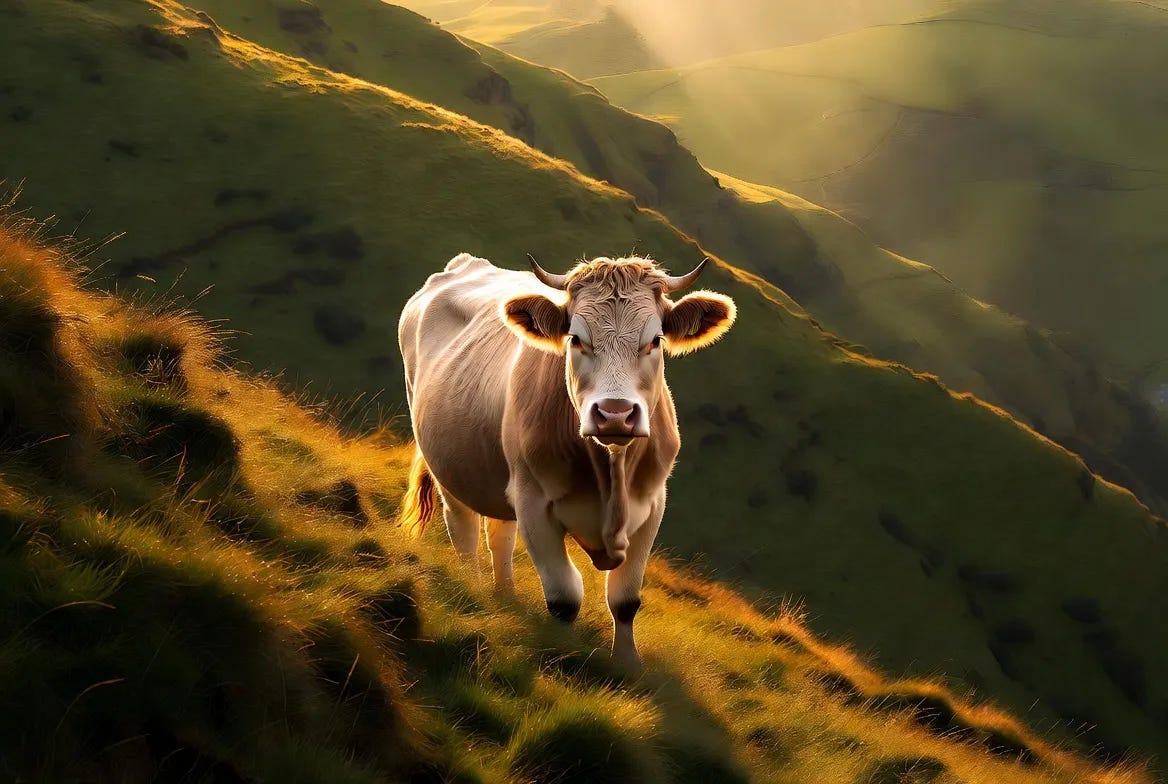
A cow can stand on a hillside that isn’t particularly useful for growing vegetables, eat plants you and I couldn’t live on, and turn them into beef and milk.
She can also eat certain leftovers and by-products from crops and food production that humans don’t normally eat.
That’s pretty remarkable when you think about it.
We talk a lot these days about complicated ways to make food more sustainable. New products. New factories. New technology.
Meanwhile, the cow has been running her own fermentation system for a very long time.
No software update required.
The Part We Sometimes Miss
This doesn’t mean every cow is raised on nothing but grass on some beautiful hillside with Julie Andrews singing in the background.
Modern agriculture is complicated.
Cattle can eat grain. Different farming systems use different feeds. There are legitimate questions about land use, animal welfare, soil health, water, methane, and how our food is produced.
Those conversations are worth having.
But there’s another side of the story that doesn’t get nearly as much attention.
Ruminants have an unusual ability to take plants and plant material humans can’t digest and turn them into food humans can eat.
That’s not an opinion. That’s biology.
And it makes me wonder whether we’ve made some of our conversations about food far more complicated than they need to be.
I Keep Coming Back to Real Food
I’ve experimented with food for most of my adult life.
At 53, I was overweight, diabetic, hurting, and headed someplace I didn’t particularly want to go.
Changing how I ate was a huge part of changing my life.
Over the years I’ve tried different versions of real-food eating. I’ve adjusted. Experimented. Been wrong. Changed my mind.
And yes, occasionally wandered face-first into something I knew perfectly well wasn’t going to make me feel good.
Apparently knowing better does not provide immunity from being human.
A couple of years ago I experimented with eating mostly animal foods.
Beef. Eggs. Butter. Salt.
What surprised me wasn’t some number on a spreadsheet.
It was how I felt.
My hunger changed. My energy became steadier. A lot of the aches and inflammation I’d been living with became quieter. I stopped thinking about food all day.
At 72, I’m still teaching movement classes every day, moving well, and enjoying my life.
That matters more to me than winning an argument about diets.
And it certainly doesn’t mean everybody should eat exactly like I do.
I’ve worked with people for years who thrive eating very differently.
My advice has become much simpler:
Eat what helps you thrive.
Not what Dave eats.
Not what your favorite doctor on YouTube eats.
Not what the latest book says every human being on Earth is supposed to eat.
Pay attention to your own body and your own life.
Maybe Simple Isn’t So Bad
One thing I do believe we’ve gotten backward is our tendency to distrust simple food while becoming strangely comfortable with food that requires an ingredient list you need reading glasses to finish.
Beef is food.
Eggs are food.
Vegetables are food.
Fruit is food.
If those foods help you thrive, wonderful.
I’m much more skeptical when we take a whole food, tear it apart, isolate pieces of it, process those pieces, add other ingredients back in, manufacture it into something new, and then tell ourselves we’ve improved upon nature.
Maybe sometimes we have.
I’m just not convinced we always have.
Interestingly, even the newest U.S. Dietary Guidelines have shifted toward a remarkably simple message:
Eat real food.
Well, look at that.
Only took us a few decades.
And Back to the Cow
There’s something beautifully simple about her.
Grass grows.
Cow eats grass.
You cannot digest the grass.
She can.
Then she turns it into highly nutritious food containing complete protein, vitamin B12, iron, zinc, and other nutrients our bodies can use.
We can argue about the perfect human diet until the cows come home.
Sorry. That one was sitting there. I had no choice.
I’d rather ask a more useful question:
What foods help you feel strong, clear-headed, energetic, and able to keep doing the things you love?
Start there.
Pay attention.
Keep the foods that help.
Question the ones that don’t.
And don’t be afraid to change your mind when your own body teaches you something new.
As for me?
I’m still pretty impressed by that cow.
The best plant-based food processor I’ve ever seen has four legs and doesn’t need to be plugged in

