
In 1971, I was a music major.
Somewhere in the middle of all that, I wrote a college paper about something that fascinated me.
What does music actually do to us?
I don’t remember every detail of that paper anymore. It’s been 55 years. I’m doing pretty well if I remember why I walked into the kitchen. 😂
But I remember the idea.
Music seemed to affect living things in ways that went far beyond entertainment.
I was fascinated by it.
Then life happened.
I stopped being a music major.
Businesses. Marriage. Kids. Alpacas. Financial disasters. A body that fell apart. RiversZen.
But music never really left.
And now, at 72, I’m beginning to think that kid writing the paper in 1971 was onto something.
Music Has Been Following Me Around My Whole Life
I don’t think I realized that until recently.
Music was there before RiversZen.
It was there while I was rebuilding my own body.
It was there when Peggy and I started teaching.
And it’s still there almost every time I teach a class.
Sometimes it’s soft and almost disappears into the movement.
Sometimes it drives the whole damn room.
Saturday morning is the obvious example.
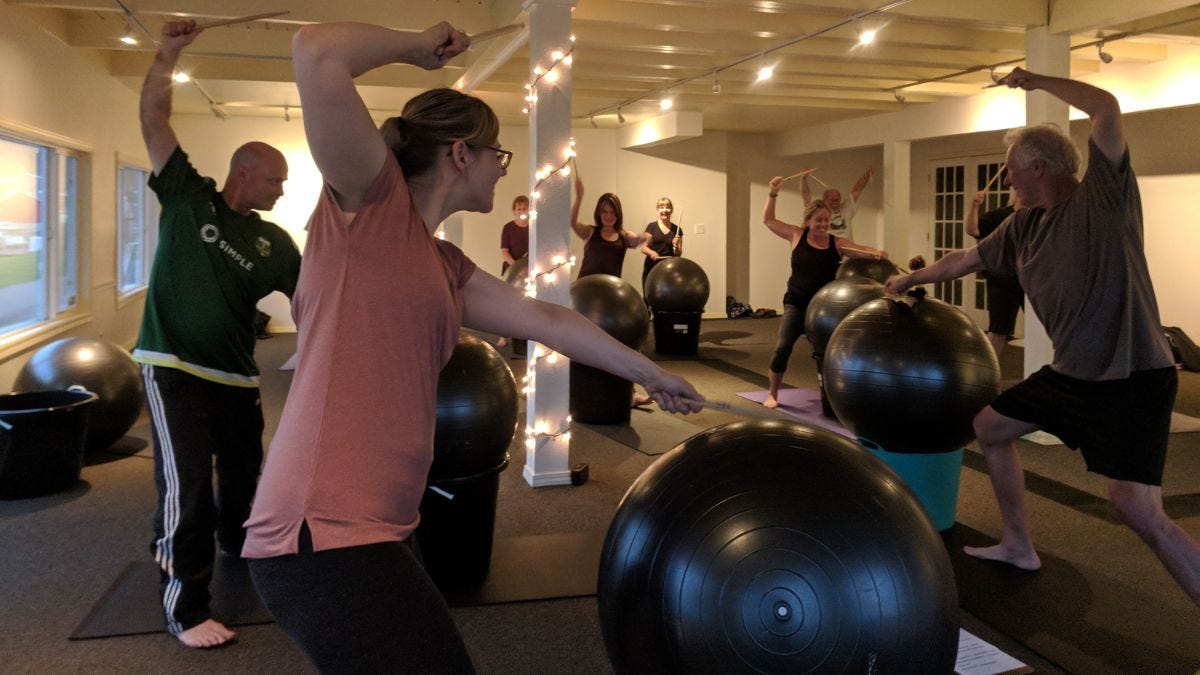
We hand people drumsticks.
Put stability balls in front of them.
Turn on music from the 50s and 60s.
And start banging away.
It’s called Drums and Fun, which may be the least scientific name ever given to anything.
That’s probably appropriate.
Because nobody walks into that class thinking:
Today I shall improve my neurological function through rhythmic auditory stimulation.
They come in to have fun.
Then Something Happens
People loosen up.
They smile.
They laugh.
They start moving bigger.
Somebody sings along.
Somebody misses the beat completely and keeps banging anyway.
Nobody cares.
The room changes.
I’ve watched it happen hundreds of times.
And you don’t need a blood test to know something happened.
People walk out differently than they walked in.
Lighter might be the best word.
For years, I simply thought:
Well, music makes people feel good.
Turns out there’s quite a bit more going on.
Science Has Been Getting Interested Too
Researchers have spent years studying how music interacts with the brain, stress, pain, memory, movement and emotion.
And I want to be careful here.
Music isn’t medicine in the sense that chemotherapy is medicine.
It isn’t a replacement for antidepressants when somebody needs them.
A good Beatles song isn’t going to repair your torn rotator cuff.
Although I’ve heard a few that might make you forget about it for three minutes. 😂
But music does affect us.
Our brains respond to rhythm.
Familiar music can stir memories we thought we’d forgotten.
Music can change how movement feels.
It can affect mood and our perception of effort and pain.
And anyone who’s ever heard the right song at exactly the right moment already knows that science isn’t describing something imaginary.
Maybe We’ve Made Health Too Serious
This is the part I’ve been thinking about.
When we talk about taking care of ourselves, everything starts sounding like work.
Exercise.
Nutrition.
Sleep hygiene.
Stress management.
Protocols.
Metrics.
Good grief.
What about joy?
What about putting on a song you love and moving around the kitchen?
What about singing badly?
What about banging on a stability ball with a pair of drumsticks while Chubby Checker is playing?
What if some of the things that help us aren’t things we have to grit our teeth and endure?
That’s increasingly important to me.
Because if we’re trying to build healthier lives so we can enjoy living...
maybe enjoying living should be part of the plan.
Try This This Week
Pick three songs.
Not songs somebody told you are relaxing.
Not “healing frequencies.”
Not a playlist designed to optimize your mitochondria.
Your songs.
The ones that do something to you.
Put them on loud enough to actually hear them.
Then don’t sit there.
Move.
Dance if you dance.
Walk.
Stretch.
Bang on something that won’t require an expensive repair.
Sing if you want.
For ten minutes, don’t measure anything.
Then notice how you feel.
That’s the experiment.
I’d love to hear what three songs you chose.
Fifty-Five Years Later
I wish I still had that college paper.
I’d like to see what 18-year-old Dave thought he’d figured out.
I’m sure parts of it would make 72-year-old Dave shake his head.
But I think I’d recognize the curiosity.
Something about music caught my attention then.
Something about it still does.
Maybe I don’t need to completely explain it.
Saturday morning I’ll turn on the music.
People will grab their drumsticks.
Somebody will lose the beat.
We’ll laugh.
And for an hour a room full of people will move, play and forget about everything else for a while.
Fifty-five years after writing that paper, I think I understand at least this much:
That’s good for us.
And sometimes that’s enough.
Thank you for reminding us of the healing power of music! The 1971 curious writer of that paper was brilliant and ahead of his time back then! And... His playful brilliance still leads us through a fabulous healing hour of Drums and Fun every week. I eagerly attend that class, and highly recommend you try it. It is pure fun and joy! The mind/body benefits are the bonus!
It's so much fun. If you haven't gone, you should!