Protein Won’t Save Muscles You Never Use!
Here’s something that surprised me when I started digging into the science.
Everyone’s obsessing over protein. How much should I eat? What kind? When should I eat it?
And protein matters, don’t get me wrong.
But it’s not the first thing. Not even close.
A massive study of over 18,000 adults aged 65 and older looked at three things: how much muscle people had, their grip strength, and their walking speed.
Then they tracked who fell, who broke bones, who lost mobility, and who died.
Turns out, how much muscle you have on a scan doesn’t predict much of anything.
But grip strength and walking speed? Those told the whole story.
People who were both slow and weak did worst. People who were neither slow nor weak did best.
Makes sense when you think about it. The question isn’t “how muscular do I look on paper?” It’s “am I strong enough to stay independent?”
The Problem Nobody Talks About
From about age 50 on, we lose roughly 0.8% of muscle mass and 2-3% of muscle strength every year.
Doesn’t sound like much, right?
But by 70, that adds up to 23% less muscle and about half your strength.
Half. Gone.
That’s the difference between getting out of a chair easily and having to rock forward to build momentum. Between catching yourself when you trip and going down hard.
Between living independently and needing help with things you used to do without thinking.
Walking Isn’t Enough
Jere’s where many people get it wrong.
I walk every day. I think everyone should. It’s great for your heart, your brain, your mood.
But walking doesn’t tell your body to keep your muscle.
Only one thing does that: Resistance exercise.
Giving your muscles a job hard enough that your body says, “Okay, I guess we still need these.”
In a survey of nearly 384,000 American adults, only 23.5% met both the aerobic and strength training recommendations. For people 55-75, it dropped to 17-18%.
People were three times more likely to walk than to do any strength work.
And there lies the problem.
Protein is the building material. But resistance exercise is the signal that tells your body to actually use that protein to maintain your muscles.
Or to put it more bluntly: Protein won’t save muscles you never use.
What Actually Works
You don’t need a gym. You don’t need fancy equipment. You don’t need to become a “fitness person.”
You just need to give your muscles something challenging to do, two or three times a week.
Stand up from a chair without using your hands. Repeatedly. Until it’s hard.
Step up on a stair. Slow and controlled.
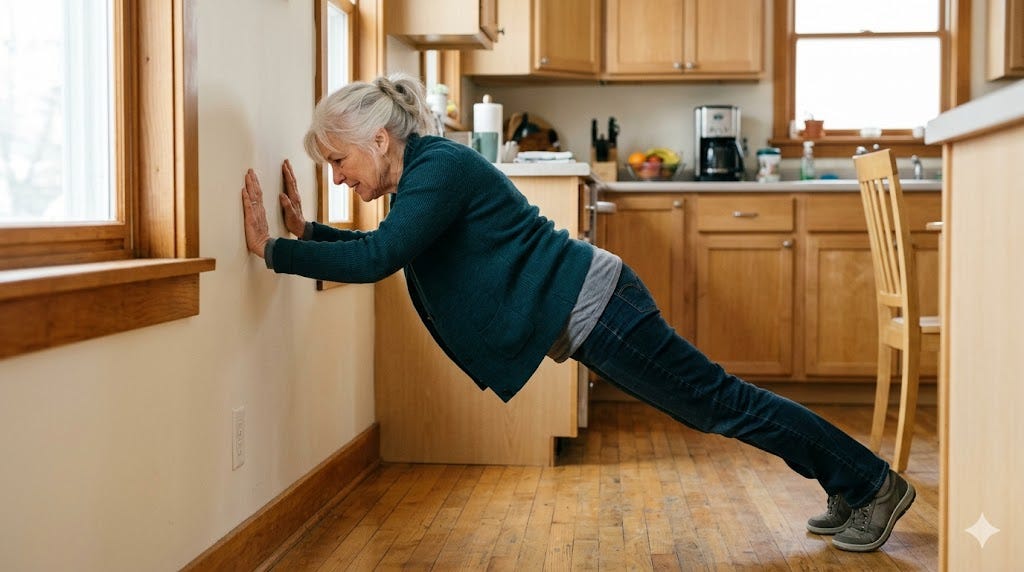
Push away from a wall or counter. Like a gentle push-up.
Carry heavy shopping bags. Lift things. Move things.
Do 8-12 reps. Rest. Do it again 2-3 times. Then move to the next movement.
The rule is simple: By the end, it should feel challenging. You should think, “I could maybe do two or three more, but not many.”
Once it gets easy, make it harder. Lower chair. Heavier bag. More reps.
Your muscles need a reason to stick around.
Then Comes the Protein
Once you’re doing the work, then protein matters more.
Older muscles become less responsive to protein. You need more of it to get the same benefit.
Most experts recommend about 1.2 grams of protein per kilogram of body weight for people over 65.
But - and this is important - if you have kidney disease, diabetes, high blood pressure, or you’re not sure if higher protein is right for you, check with your doctor first.
The protein helps. But only if your muscles have a job to do.
The Real Question
Not: “Should I get a DEXA scan to measure my lean mass?”
But: “Does my week contain anything that asks my muscles to stay useful?”
If it doesn’t, that’s the first thing to change.
Because at 72, I can tell you: Strength isn’t about looking good. It’s about staying independent.
Getting out of chairs. Carrying things. Not falling. Not breaking bones. Not needing help with ordinary life.
That’s worth a couple of slightly annoying strength sessions a week.
What About You?
Do you do any deliberate strength work? Or is this something you know you’ve been putting off?
What usually gets in the way - time, not knowing where to start, thinking walking is enough?
Drop a comment. Let’s talk about what’s realistic and what actually works.

