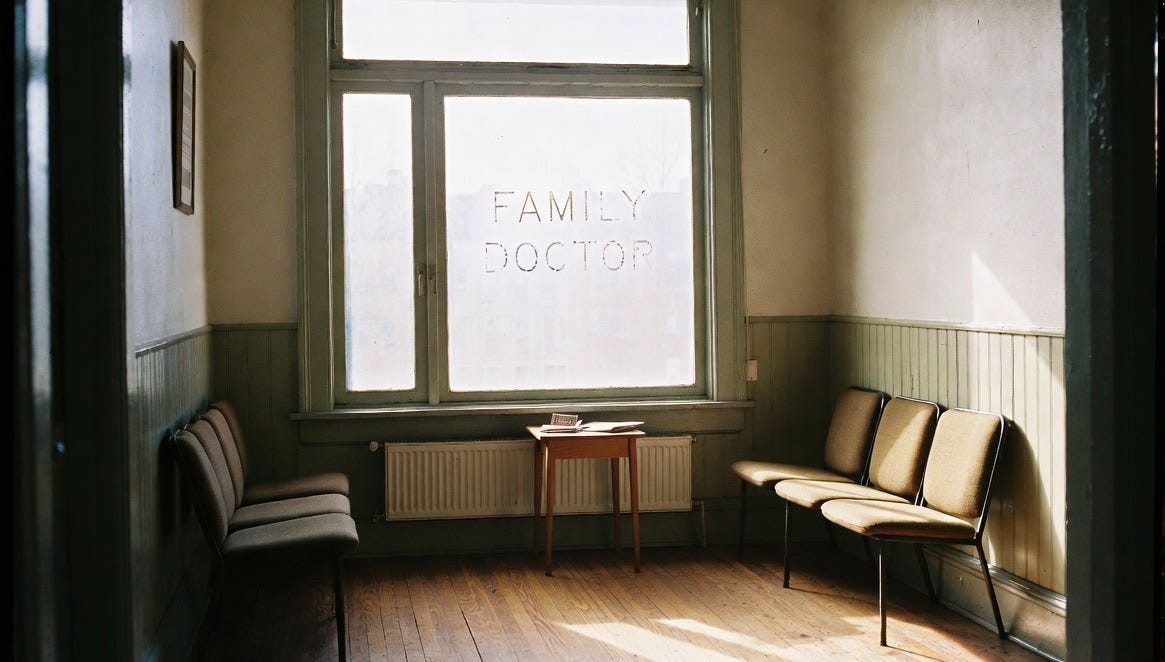
When I was a kid, you went to the doctor when something was wrong.
You broke your arm.
You needed stitches.
You had a fever that wouldn’t quit.
Otherwise, you pretty much went about the business of living your life.
My parents didn’t have a cardiologist, an endocrinologist, a dermatologist and a collection of specialists whose names required their own address book.
They had a family doctor.
They knew his name.
They saw him when they needed him.
That was normal.
Today I teach people mostly in their sixties and seventies, and sometimes I listen to them talk before class.
One has a dermatologist appointment.
Another just saw the cardiologist.
Someone has bloodwork tomorrow.
Someone else is waiting for imaging.
Then there’s the follow-up appointment for the appointment they had last week.
I’m not making fun of them.
These are people I care about.
But sometimes I stand there listening and think:
When did being responsible for your health start requiring this many appointments?
I don’t have a simple answer.
And I’m becoming increasingly suspicious of simple answers anyway.
Healthcare has changed enormously since my parents were young.
We can detect things we couldn’t detect then.
We can treat things that once killed people.
We have screenings that can find serious problems before someone feels sick.
That’s progress.
I’m grateful for it.
Especially now.
When Peggy was diagnosed with Non-Hodgkin’s lymphoma this year, we weren’t interested in romantic stories about how much better everything was fifty years ago.
She had cancer.
She needed help.
Modern medicine had something to offer her, and thank God it did.
Her tumor responded remarkably quickly to chemotherapy. She continued teaching throughout treatment and handled it extraordinarily well.
I’ve thought about that experience a lot.
Because it helped me understand a distinction I’ve probably been circling around for years.
There’s a difference between having access to medicine and building your life around medicine.
Those aren’t the same thing.
I don’t want to go backward.
I don’t want the medicine my parents had.
I want the medicine we have today.
I just don’t necessarily want medicine occupying more and more of my life when I’m well.
And that’s where I think there’s a conversation worth having.
When did more monitoring automatically become better health?
When did another test automatically become responsible?
When did not having an appointment on the calendar start feeling almost negligent?
I don’t know.
But I do know something from nearly twenty years of working with people.
Most health is built between appointments.
Your doctor can tell you your blood pressure.
They can’t take your walk.
A blood test can tell you something about what’s happening inside your body.
It can’t decide what you eat tonight.
A bone-density scan can identify a problem.
It can’t make your muscles stronger.
Your cardiologist can give you valuable information about your heart.
They can’t put you to bed tonight.
None of this makes the doctor, test, scan or treatment unimportant.
It puts them in perspective.
They’re tools.
Sometimes incredibly important tools.
But they’re not your health.
You are living that part every day.
Peggy didn’t know cancer was coming.
For seventeen years before it arrived, she moved her body. She taught classes. She ate real food. She slept. She managed stress. She kept showing up.
Did those things prevent cancer?
Obviously not.
Did they make her chemotherapy destroy the tumor?
I can’t tell you that.
But do I believe those seventeen years helped build the strength and resilience she carried into treatment?
Absolutely.
She didn’t start building herself when she got the diagnosis.
She brought seventeen years with her.
That’s the relationship with medicine I want.
Build health while you’re well.
Use medicine when you need it.
And be grateful it’s there.
That doesn’t tell you how many doctors you should have.
Maybe you need seven.
Maybe you need one.
Maybe you’re going through a season of life where it seems like every Tuesday comes with another waiting room and a clipboard.
That’s between you and the people helping care for you.
I’m not asking you to cancel an appointment.
I’m asking something much more interesting.
Is all this healthcare helping me build health?
Because those two things can overlap.
But they’re not automatically the same thing.
Maybe an appointment catches something important.
Wonderful.
Maybe a medication gives you the stability you need to start making other changes.
Wonderful.
Maybe physical therapy gets you moving again.
Wonderful.
And maybe there’s also something you’ve slowly handed over to the medical system that still belongs to you.
Your movement.
Your food.
Your sleep.
Your strength.
Your relationships.
Your time outside.
Your willingness to pay attention to your own body.
That’s the part I don’t want us to forget.
My parents’ generation certainly didn’t have everything figured out.
Neither does ours.
Maybe the goal isn’t to return to the way they lived.
Maybe it’s to keep the best of what we’ve gained without surrendering something valuable along the way.
Medicine when we need medicine.
And ownership of our health every day in between.
Your doctor’s office can be part of a healthy life.
It just doesn’t have to be the center of one.

