
One of the things we hear from people is that their balance isn’t what it used to be.
Maybe they notice it putting on their pants. Maybe turning around feels less certain. Maybe they reach for something and suddenly find themselves taking an extra step.
Or maybe they’ve started avoiding things because they’re afraid of falling.
The good news is that balance is something you can work on.
Peggy and I have spent years
incorporating balance into our classes. And one thing we’ve learned is that you don’t improve balance by simply standing there hoping you won’t fall over.
You have to challenge it.
But you also have to give yourself a safe way to practice.
First, find out what needs work…
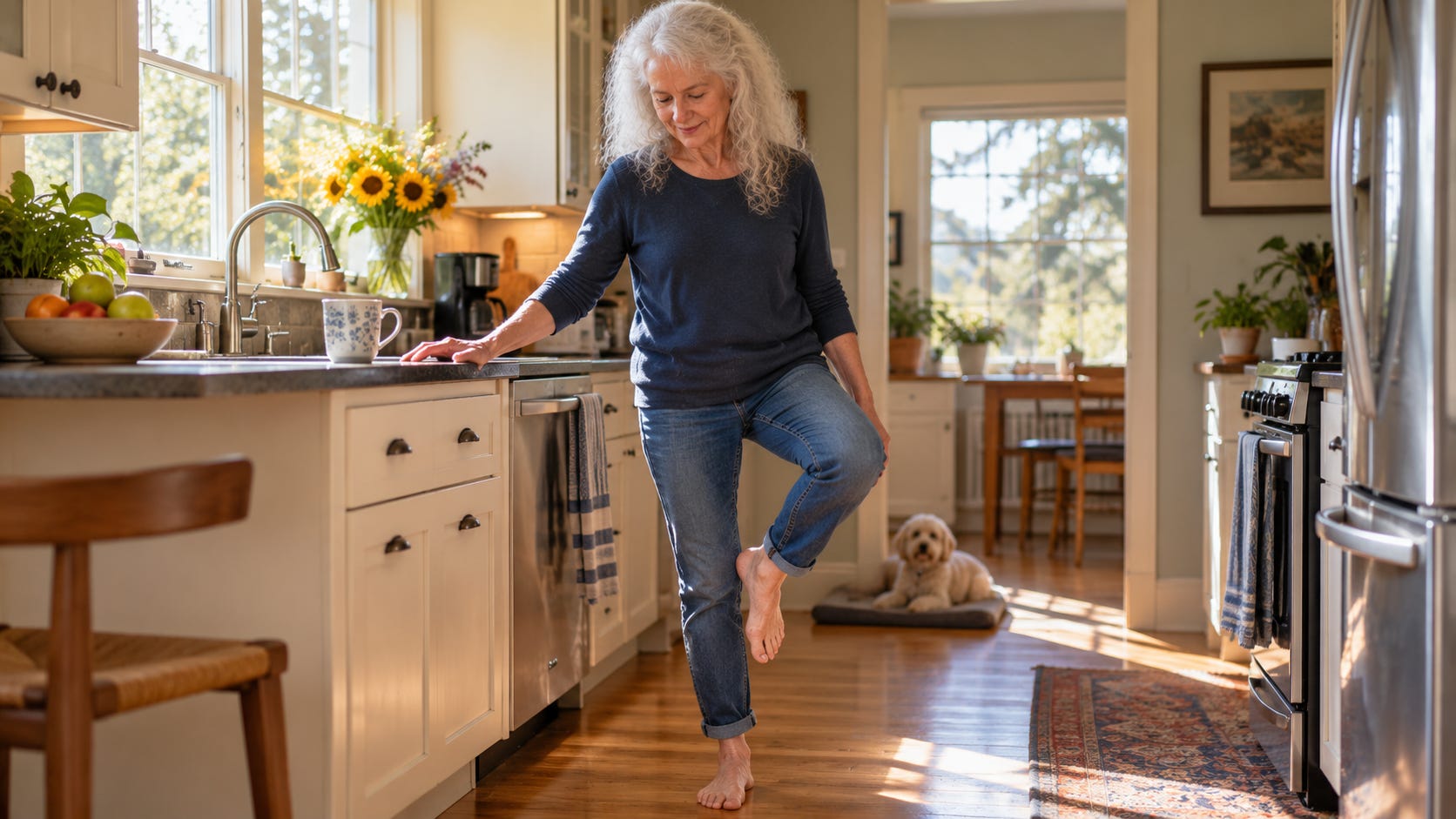
Stand near a sturdy kitchen counter. Not a rolling chair, not something that might move. Something solid.
Keep a hand close enough to steady yourself whenever you need it.
Try these three things.
1. Shift your weight.
Stand with your feet comfortably apart. Slowly move more of your weight onto your right foot, then your left.
Don’t lift either foot yet.
Notice whether one direction feels easier. Can you move smoothly, or do you suddenly have to catch yourself?
2. Bring your feet closer together.
Start with your normal stance, then bring your feet a little closer.
Hold the counter as needed.
Notice how changing the distance between your feet changes the amount of work required to stay steady.
Don’t worry about how long you can hold the position. Pay attention to what your body is doing.
3. Try a supported single-leg balance.
Shift your weight onto one foot. Keep your fingertips on the counter and lift the other heel, leaving its toes touching the floor.
If that feels comfortable, try lifting the foot slightly.
Do both sides.
Is one easier? Does your hip shift? Do you grip the counter harder on one side?
We’re not looking for a score. We’re looking for information.
Now let’s work on it
Exercise 1: Slow weight shifts
Stand facing your counter, with both hands available for support.
Move your weight from one foot to the other.
But don’t just rush from side to side.
Feel what happens as your weight travels across your feet. Notice your ankles, knees, hips, and the little adjustments your body makes along the way.
Try ten slow shifts.
Then change direction, moving slightly forward toward your toes and back toward your heels without lifting either end of your feet.
Keep the movement small enough that you remain in control.
Exercise 2: Supported marching
Hold the counter.
Slowly lift one foot, lower it, and lift the other.
Start with small lifts. There’s no prize for getting your knee up to your chest.
As you become steadier, spend a little more time balancing on the supporting leg.
Try five to ten lifts on each side.
If you need both hands on the counter, use them. If one hand is enough, that’s fine, too.
The goal isn’t to get rid of support as quickly as possible.
It’s to develop better control.
Exercise 3: Step and return
Stand facing the counter.
Take a small step to the side with your right foot. Shift some weight onto it, then bring it back.
Repeat with the left.
Next, try a small step backward, then return.
Pay attention to how you transfer your weight. Don’t just throw your foot out and hope the rest of you follows.
Try five steps in each direction on each side.
Keep them small and controlled.
Exercise 4: Turn without rushing
Many people are reasonably steady standing still but become less confident when they turn.
With a sturdy counter within reach, practice turning your body a little to one side by taking small steps.
Then return.
Turn the other direction.
Let your feet move. There’s no need to twist yourself around on planted feet.
Start with quarter turns, slowly enough that you can notice where your weight is going.
If turning causes dizziness, stop. That’s something to discuss with a healthcare professional rather than push through.
How do you make it harder?
Not by making it dangerous.
You can gradually increase the challenge by:
Using less hand support when you’re genuinely steady.
Slowing the movement so you have to control every part.
Holding a supported single-leg position a little longer.
Increasing the size of a step without losing control.
Practicing smooth transitions between movements.
Change one thing at a time.
If you’re suddenly grabbing for the counter, you’ve probably increased the difficulty too much.
There’s no advantage to practicing a fall.
What should you do this week?
Pick two or three exercises and spend five to ten minutes working on them most days.
Start at a level where you can succeed while still having to pay attention.
Notice which side is more difficult. Notice whether your movements become smoother. Notice whether you need a little less support.
After a week, try the same movements again.
Don’t worry if the changes are small.
You’re teaching your body to handle situations that once felt uncertain.
And remember, balance isn’t something you use only when you’re standing on one foot.
You use it every time you move.
A safety note: If you’ve been falling, have new or unexplained balance problems, experience dizziness, or cannot practice safely even with support, get evaluated rather than trying to solve it with home exercises alone. A physical therapist can help identify what’s contributing to the problem.