
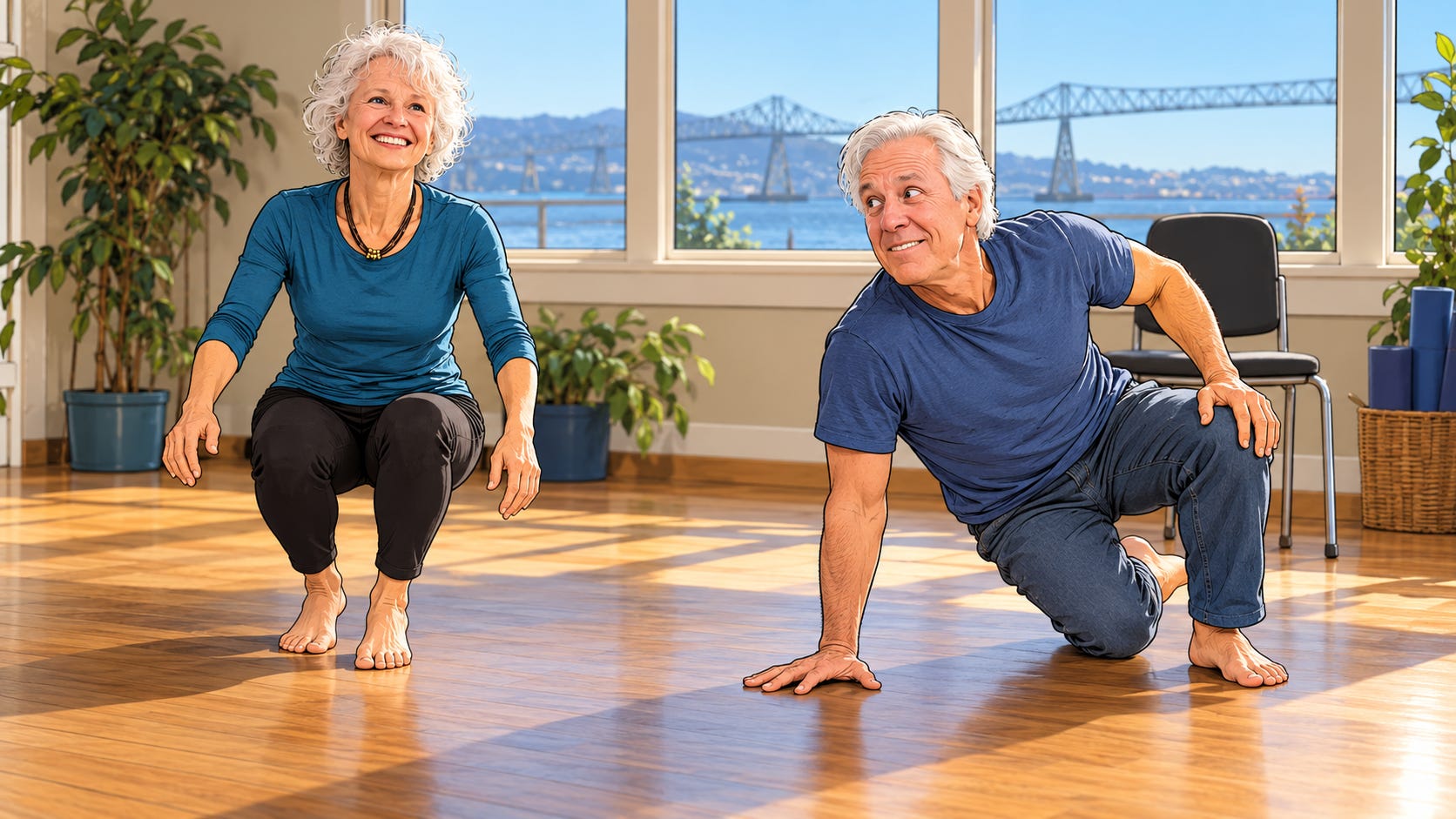
There’s a funny thing about the floor.
You don’t think much about being able to get down there until you start wondering whether you’re going to be able to get back up.
Maybe you want to play with your grandkids.
Maybe you want to get down there with the dog.
Maybe there’s a stretch you want to do that just works better on the floor.
Or maybe something rolled under the damn couch.
Being able to get down on the floor and get back up is one of those ordinary abilities that turns out to be a much bigger deal than you thought.
Peggy said something when we were talking about this that pretty much nails it.
It’s like being able to reach your arms overhead and get something off the top shelf.
You don’t ever want to lose that ability.
The longer you can keep doing these ordinary things, the longer you have freedom.
The longer you can run your own life.
So when somebody tells Peggy or me, “I’m having trouble getting up from the floor,” we don’t immediately tell them they need stronger legs.
First we ask them what’s happening.
Then, if they can safely do it, we ask them to show us.
How are you actually getting down there—and how are you trying to get back up?
That’s usually where we start.
First, don’t turn this into a test
Before somebody demonstrates this for us, Peggy makes sure they’re in a good spot.
Put a chair nearby. Get close to a post or something else solid. Give yourself something you can grab if you need it.
We’re trying to figure something out. We’re not holding auditions for Cirque du Soleil.
Then get down on the floor the way you normally would.
Pay attention to what happens.
Do you immediately reach for something?
Do you avoid one knee?
Does one leg do most of the work?
Is there a point where you hesitate?
Does something hurt?
Do you basically drop the last few inches because you can’t control the trip down?
Peggy watches the trip down just as carefully as the trip back up.
And once you’re down there, stay there for a minute.
Get comfortable. Get your wits about you.
This is especially important if getting on the floor already makes you nervous. We’ve worked with people who were genuinely anxious about doing this because they’d had trouble before.
There’s no reason to rush.
Now let’s figure out how you’re going to get up.
There isn’t one right way
This is important.
You do not have to be able to sit cross-legged and rise straight up without using your hands.
Peggy can do that.
It’s actually rather irritating.
I’ve never figured out which muscles she’s firing to levitate herself off the floor like that.
I can’t do it.
What I can do is get off the floor a bunch of different ways.
And that’s what I’d rather give you.
Options.
Hands Down, Spin and Stand
This is one of my favorites because a lot of people find it surprisingly easy.
Start seated on the floor. Cross-legged works well if that’s comfortable for you.
Let’s say you put your left hand on the floor beside you.
Use that hand for support as you begin rotating your body toward the left. Your right foot comes underneath you as you spin, while your left leg moves back and out of the way.
Keep rotating until you’ve brought your feet underneath you enough that you can come up to standing.
Don’t worry about making it pretty.
Do it slowly.
Then try the other direction.
You may discover one side makes absolutely no sense and the other side feels almost ridiculously easy.
Use the one that works.
Table → Down Dog → Walk Up
Here’s another way.
From sitting on the floor, make your way onto your hands and knees.
Now you’re in what we call table position.
Curl your toes underneath you. Press through your hands and feet and lift your bottom into the air.
If you’ve done yoga, you’ll recognize Downward-Facing Dog.
If you haven’t, don’t worry about what it’s called. Your hands and feet are on the floor and your butt is in the air.
From there, start walking your feet toward your hands.
As your feet get closer, bring yourself more upright until you can stand.
I’ve seen a lot of people who thought they couldn’t get off the floor discover that they could do this.
They didn’t suddenly get stronger.
They found another route.
Obviously this isn’t going to be everybody’s route. If putting weight through your hands or wrists is a problem, try something else.
Peggy’s Kneeling Method
Start seated and make your way onto your knees.
Bring one foot forward so you’re in a half-kneeling position—one knee remains on the floor and the other foot is planted in front of you.
Let’s say your left knee is down and your right foot is forward.
Bring your hands onto your right thigh or knee.
Lean your weight forward over that foot. Press through your hands and front leg and bring yourself up to standing.
Try the other leg too.
Again, one side may work much better than the other.
That’s useful information.
If one of these gets you off the floor comfortably, great.
Practice it.
Then learn another one.
Having more than one way to get yourself off the floor is a pretty useful thing.
This is a skill
There’s some interesting research behind this.
Researchers have taken older adults who had difficulty getting off the floor and taught them different ways to do it using different intermediate positions.
They got better at it.
And in a recent study, older adults who actually practiced getting off the floor improved considerably more than people who only watched demonstrations and talked about the techniques.
That makes sense to Peggy and me.
Getting off the floor isn’t only about strength.
It’s a skill.
And skills get better when you practice them.
So don’t wait until you fall down or find yourself underneath the kitchen sink trying to retrieve something before discovering whether you still know how to get yourself back up.
Every once in a while, get on the floor on purpose.
Then get back up.
What if none of those methods works?
Now we’re asking a different question.
What’s actually stopping you?
Is it your hip?
Your knee?
Your ankle?
Your foot?
Do your wrists make it difficult to push into the floor?
Do you lack the leg strength to bring yourself upright?
Is balance the problem?
Or have you had enough trouble doing this that the whole idea now scares the hell out of you?
Those aren’t all the same problem.
And they’re not going to have the same solution.
This is where Peggy and I start looking at the person rather than the problem.
We’ve had people where an entire private session was basically devoted to getting down on the floor and getting back up.
That’s not wasting a session.
That’s working on something that matters.
And sometimes the answer is that you’re simply not ready to start on the floor.
That’s okay.
Bring the floor up to you
This is something Peggy does a lot.
If the floor is too much right now, don’t start there.
Start with a chair.
Sit down.
Stand up.
Sit back down with as much control as you can instead of dropping the last few inches.
Stand again.
If that’s where you are right now, that’s where you start.
Peggy also uses stairs for this.
Maybe you sit on the third step and stand up.
Can you do that comfortably?
Good.
Eventually try the second step.
Then the first.
You’re doing the same basic job, but each time you’re starting a little lower.
Eventually you may be able to start from the floor.
You can do something similar with a firm cushion, bolster or folded blankets underneath you.
Raise the starting point until you find a height where you can succeed.
Then work your way lower.
I like this because it changes the question.
Instead of:
Can I get off the floor or can’t I?
Now the question becomes:
How low can I comfortably start today?
Maybe today it’s the third stair.
Fine.
That’s where you work.
You’re trying to develop a technique you don’t have yet.
Using the stairs, a chair or a bolster isn’t cheating.
It’s how you build something.
Sometimes you need more oomph
Technique can make an enormous difference, but sometimes the problem really is strength.
If you can’t stand up from a chair without a lot of assistance, getting yourself off the floor is going to be considerably harder.
So start with the chair.
Practice sitting down and standing back up.
Build your legs.
Your quads and hamstrings matter. Your hips matter. Your feet and ankles matter. Depending on how you’re getting up, your arms and shoulders may matter too.
And keep moving all of them.
Strength and mobility aren’t separate little boxes as far as we’re concerned. You need a body that can produce force and get itself into the positions where you need that force.
We’ve spent a lot of years teaching movement, and one thing becomes pretty obvious:
Your body gets pretty good at the things you keep asking it to do.
It also gets pretty good at not doing the things you stop asking it to do.
And yes, there’s the falling thing
Sometimes you end up on the floor when you didn’t intend to.
If you’ve fallen and you’re injured, that’s obviously a different situation.
But sometimes people fall, aren’t seriously hurt, and then discover they can’t get themselves back up.
Research has found that this can become a serious problem in its own right. Some older adults who fall spend a long time on the floor simply because they can’t get back to standing.
That’s another pretty good reason to practice this while you don’t need it.
If you ever find yourself sitting there thinking, “Well, shit. Now what?” it would be nice if this weren’t the first time in ten years you’d tried to get yourself up.
But I don’t want to make this whole thing about falling.
That’s not really why Peggy and I care so much about it.
It’s about freedom
It’s getting down on the floor with your grandkids.
Playing with the dog.
Stretching.
Gardening.
Reaching underneath something.
Doing whatever the hell you wanted to do down there without first wondering how you’re going to escape.
Peggy put this in the same category as reaching overhead and getting something off a shelf.
She’s right.
These are little freedoms you don’t think about very much.
Until you lose one.
Then it isn’t little anymore.
So don’t worry about whether you can levitate off the floor like Peggy.
I can’t either.
Find a way that works.
Then find another.
And if you’re not ready for the floor yet, start higher.
The floor will still be there when you’re ready.