
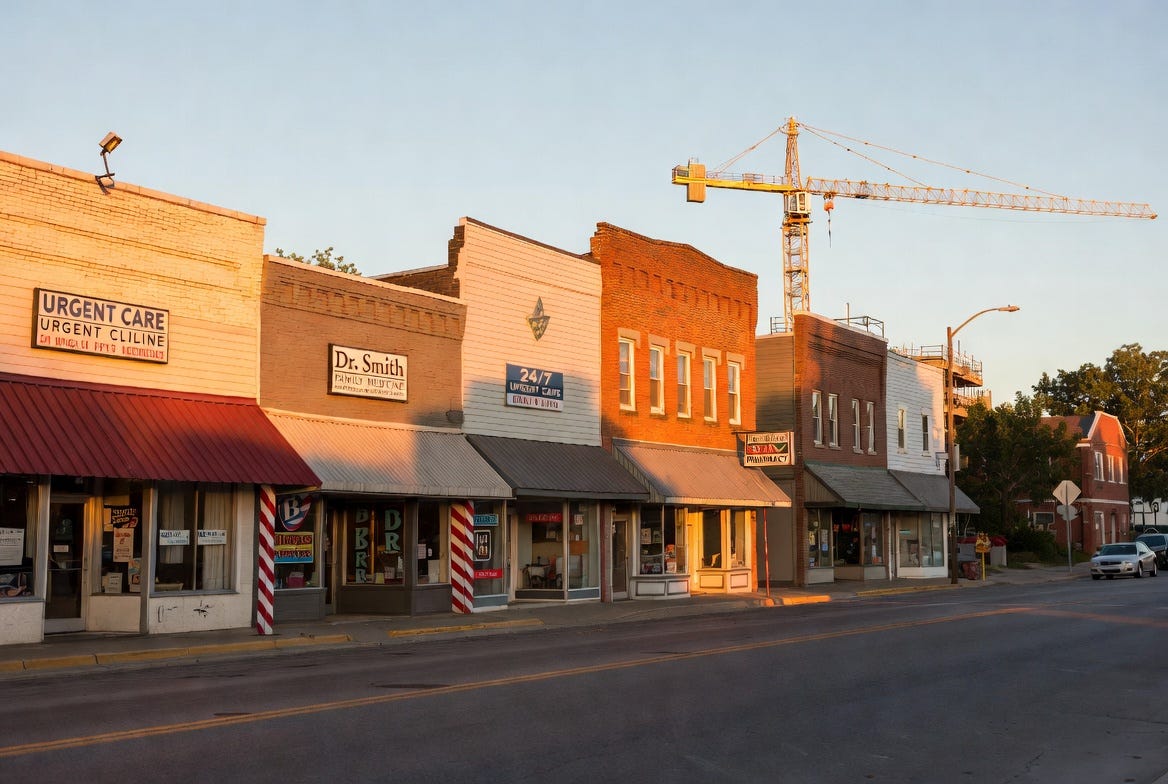
I drove through town recently and started noticing buildings.
Three places that used to be something else are now urgent care clinics.
The old car dealership is a specialty practice.
Another lot is being turned into medical offices.
The hospital has expanded.
This is a small town.
And healthcare seems to be physically growing all around us.
I’m not complaining about that. People need doctors. They need hospitals. Sometimes they need really sophisticated medicine.
Believe me, our family learned that lesson this year.
But once I started noticing the buildings, I started noticing something else.
The calendars.
I teach movement classes six days a week. Many of our students are in their sixties and seventies, and some of their schedules make mine look relaxing.
Dermatologist Tuesday.
Cardiologist Thursday.
Bloodwork before the next appointment.
Imaging after that.
Follow-up with the specialist.
Then another specialist the first specialist referred them to.
They come to class with little bandages on their arms and faces from procedures.
They compare specialists the way people used to compare restaurants.
And sometimes I listen to all of this and think:
When did staying healthy become a part-time job?
I don’t mean that sarcastically.
These are smart, responsible people.
They’re doing what they’ve been told responsible people do.
Get the test.
Keep the appointment.
Watch the numbers.
Take the medication.
Schedule the follow-up.
There can be very good reasons for every one of those things.
But I’ve started wondering whether we’ve blurred two words that aren’t quite the same.
Healthcare.
And health.
Healthcare is what happens when you get the mammogram, see the cardiologist, have the bloodwork, fill the prescription, or get the treatment.
Sometimes healthcare saves your life.
Health is something else.
Health is what you’re building during all those ordinary hours when nobody in a white coat is watching.
And Peggy reminded me just how important that distinction can be.
This year she was diagnosed with Non-Hodgkin’s lymphoma.
Suddenly, this wasn’t a philosophical conversation about healthcare anymore.
She had cancer.
She needed medicine.
And we were incredibly grateful it was there.
She chose chemotherapy. Her tumor responded remarkably quickly. She continued teaching throughout treatment and handled the experience so well that her oncologist was surprised.
I wasn’t.
Not because I knew what chemotherapy would do to the cancer. I didn’t.
And I’m certainly not going to tell you that seventeen years of healthy living made the chemotherapy destroy her tumor. I can’t know that.
But do I believe those seventeen years mattered enormously to the woman who walked into treatment?
Absolutely.
Peggy didn’t start taking care of herself when the diagnosis arrived.
For seventeen years she’d been moving her body.
Teaching.
Eating real food.
Sleeping.
Managing stress.
Showing up.
Day after ordinary day.
She wasn’t preparing for cancer.
She was living.
And when something we never expected came knocking at the door, she didn’t have to start building strength.
She brought it with her.
I’ve always talked about building your body like a fortress.
Not because a fortress guarantees nothing bad will ever happen.
Clearly it doesn’t.
Bad things happen to healthy people too.
The point of building the fortress is having something there when the storm arrives.
Medicine treated Peggy’s cancer.
But seventeen years of healthy living helped build the woman who went through that treatment.
I think both things matter.
That’s also why I don’t want this conversation to become doctors versus lifestyle.
That’s silly.
If you need the cardiologist, go to the cardiologist.
If you need the scan, get the scan.
If you need medicine, use medicine.
And if someday you’re sitting across from an oncologist hearing the word cancer, you’ll be very glad brilliant people spent their lives figuring out what to do next.
We certainly were.
But don’t confuse receiving healthcare with building health.
Nobody can do that second part for you.
Your doctor can’t take your walk.
Your cardiologist can’t get you off the couch.
Your pharmacist can’t choose your dinner.
Your physical therapist can’t make you move on the other six days of the week.
Your sleep doesn’t come in a prescription bottle.
Neither does time outside.
Neither does laughter.
Neither does having people in your life you actually enjoy being around.
And perhaps that’s what bothers me when I watch more medical buildings going up while listening to people describe calendars filled with appointments.
We’ve become extraordinarily good at managing health problems.
I’m not sure we’ve become equally good at helping people build health.
Those aren’t the same thing.
I’m 72. Nineteen years ago I was 98 pounds heavier and dealing with type 2 diabetes. Changing how I ate and how I moved changed the direction of my life.
That didn’t make me bulletproof.
Peggy’s experience reminded me that none of us are.
It did teach me something else.
The ordinary Tuesday matters.
The walk nobody applauds.
The simple meal nobody photographs.
The class you almost skipped.
Going to bed.
Getting outside.
Moving your body when nothing hurts and nobody has frightened you with a diagnosis yet.
Those little decisions can seem almost laughably insignificant.
Until the day they aren’t.
So yes.
Go to the appointment when you need the appointment.
Get the test.
Use the medicine.
Thank God for the people who know what to do when something goes seriously wrong.
Then go home and remember something equally important.
Healthcare is there when you need help.
Health is something you’re building every day.
Most of that work will never happen in a medical building.
It happens where it always has.
In the life you live between appointments.
This is so inspirational. Thank you!!! I can see myself coming back to read this when I want to skip the workout or walk or eat something that I know is what I consider an occasional indulgence.