
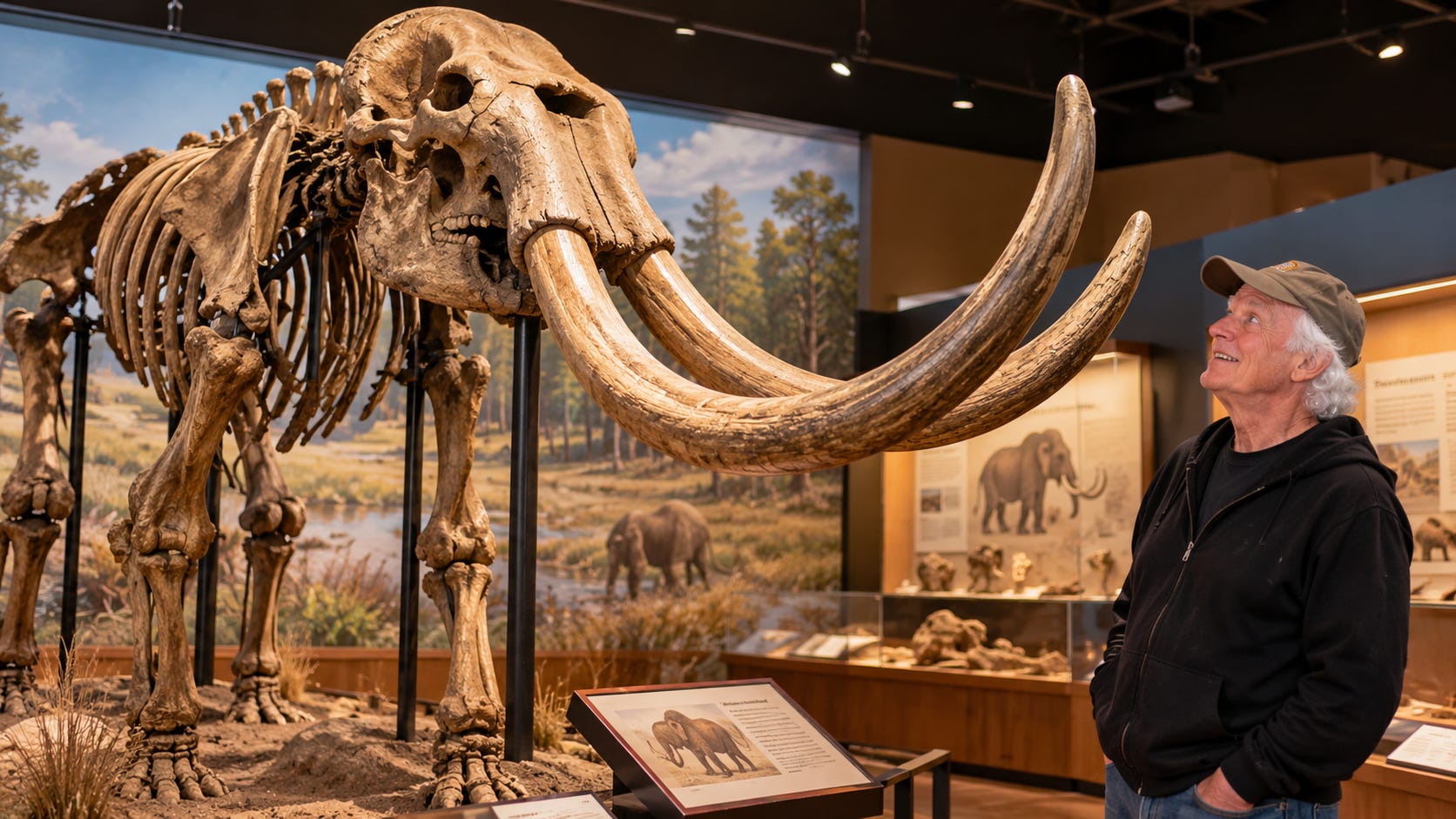
Somewhere in southern Iowa, about 13,600 years ago, a mastodon was wandering around what would eventually become Wayne County.
We don’t know much about her life.
But we know where she ended up.
In a creek bed.
And she stayed there for a very long time.
Then, in 2022, somebody noticed an unusually large bone sticking out of the ground.
That’s how the story of Dolly began.
Or at least the modern part of it.
That’s a pretty big bone
The discovery attracted the attention of the University of Iowa’s Office of the State Archaeologist.
In 2024, archaeologists and volunteers began excavating the site.
What they uncovered turned out to be the most complete mastodon specimen ever found in Iowa.
There was a skull, part of a tusk, and at least twenty additional bones from the same animal.
And these weren’t ordinary fossils.
At approximately 13,600 years old, Dolly’s remains were still bone. They hadn’t been replaced by minerals and turned to stone.
Which sounds wonderful until you try to move a 13,600-year-old skull that’s been sitting in wet clay.
The bones were incredibly fragile.
So the researchers spent the next two years cleaning, stabilizing, and studying them.
University students helped with the painstaking preservation work.
They even created a three-dimensional digital representation of Dolly.
Meanwhile, the people of Wayne County were waiting for their ancient neighbor to come home.
A little help from the neighbors
One of the things I like about this story is how many people got involved.
The landowners supported the excavation. Local residents helped raise money. Volunteers worked alongside the archaeologists.
And the plan wasn’t to send Dolly off to some enormous museum hundreds of miles away.
She was going to stay in Wayne County.
At the Prairie Trails Museum in Corydon.
The museum’s director, Brenda DeVore, had been there during the excavation. She remembered the clay, the work, and the long process of getting everything out of the ground.
Two years later, she was helping prepare the exhibit.
On September 26, 2026, Dolly finally made her public debut.
The museum held a ribbon-cutting ceremony, and the community turned out to welcome her.
Thirteen thousand six hundred years after she roamed the area, Dolly was back in Wayne County.
Although I suppose she’d never really left.
There was something else in the creek
The researchers made another interesting discovery while excavating Dolly.
They found stone tools indicating ancient human activity nearby.
That doesn’t prove people hunted Dolly, or even that they ever encountered this particular animal.
But it suggests that people and mastodons may have occupied the same landscape in southern Iowa thousands of years ago.
Imagine that for a moment.
A place where people now drive pickup trucks, raise families, and go about their ordinary business was once home to enormous, elephant-like animals.
And perhaps people who watched them move across the landscape.
We tend to think of history as something that happened somewhere else.
Ancient Egypt. Rome. Greece.
But sometimes it’s right there in the creek behind somebody’s property.
Waiting for somebody to notice an unusually large bone.
Welcome home, Dolly
I wonder what the people who first spotted that bone thought they were looking at.
Probably not the beginning of a four-year project involving archaeologists, university students, volunteers, preservation specialists, and a new museum exhibit.
And certainly not a homecoming celebration for an animal that died before anyone had invented the idea of Iowa.
But that’s what happened.
Dolly spent more than thirteen thousand years in the ground.
Then a few people got curious.
And now she’s got her own exhibit.
Not a bad second act for a mastodon.