
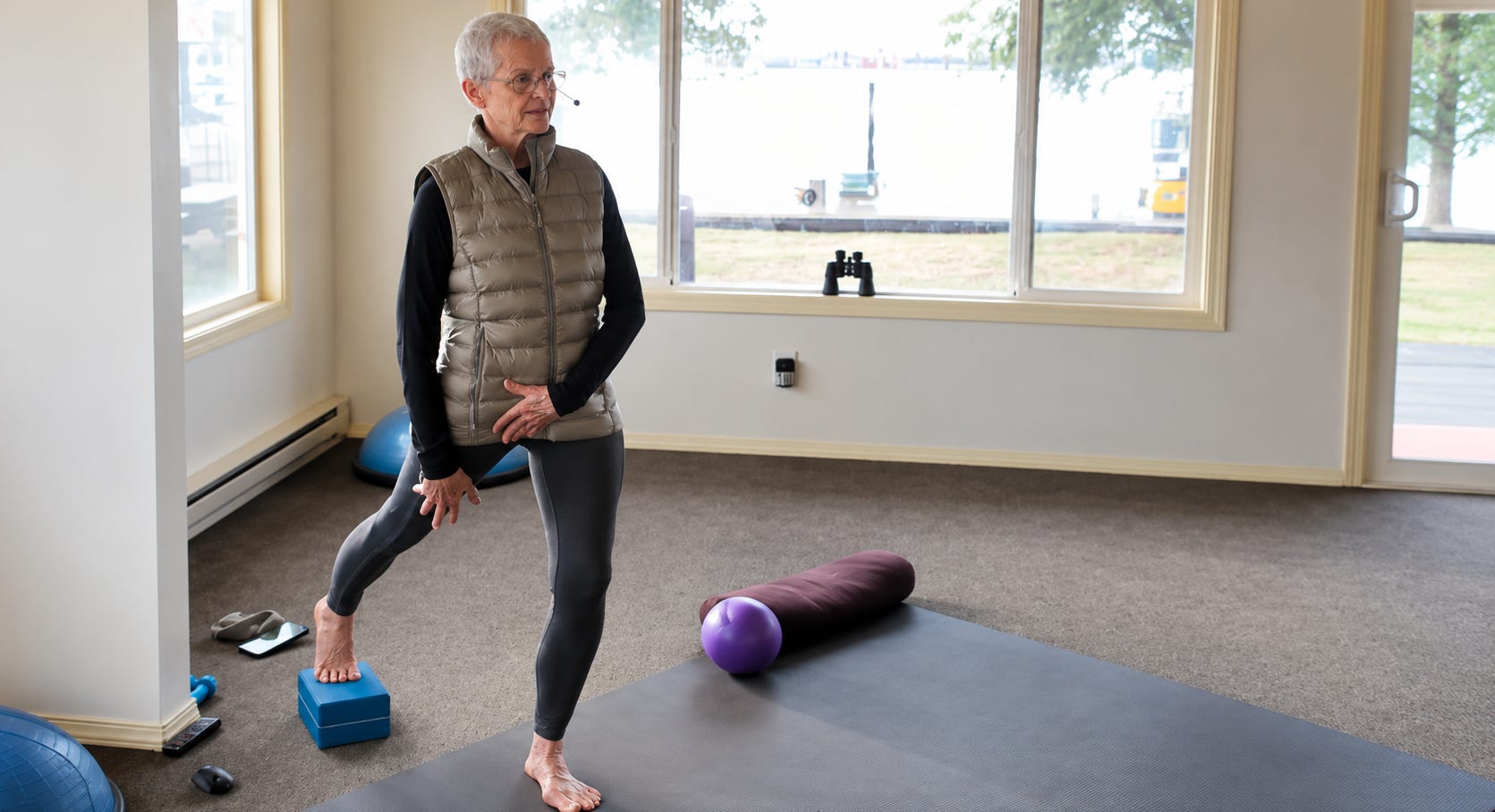
Peggy said something in class the other day that I almost missed.
That happens more often than you might think.
We have been teaching together for a long time, and sometimes one of us will say something in the middle of class that sounds like nothing particularly profound. Then later I realize there was a whole lot hiding inside one sentence.
The other day Peggy was showing a movement for the core. Nothing dramatic. She was talking about leaning back a little farther as you got stronger and more comfortable with it.
Then she said:
“We want to challenge it, but to never put it at a disadvantage.”
I wrote that down.
Because after all these years, I think that may be one of the better descriptions of how we approach movement.
Challenge it. Don’t put it at a disadvantage.
Those are not the same thing.
Somewhere along the way, challenge became almost synonymous with suffering.
If you’re not struggling, it isn’t doing anything.
If your legs aren’t shaking, go lower.
If eight is hard, do ten.
If you can touch your toes, try to get your palms on the floor.
If you can balance for thirty seconds, close your eyes, stand on a pillow and perhaps release a small animal into the room.
Okay, I made up the animal…
Although around RiversZen that isn’t entirely outside the realm of possibility.
We believe in challenge.
Absolutely.
Your body needs reasons to adapt. Muscles need to work. Balance needs to be challenged. Sometimes you need to go a little farther than you went last time.
But there’s a point where adding difficulty doesn’t necessarily make something better.
Sometimes it just takes away your options.
That’s the part Peggy’s sentence got me thinking about.
If you’re practicing balance and standing in the middle of the room scares the hell out of you, use the wall.
You’re still balancing.
In fact, with a hand near the wall, you may be willing to explore farther because you know you have somewhere to go if things get interesting.
The wall didn’t make the movement less effective.
It may have made you more willing to challenge yourself.
That’s a very different way of looking at support.
We see the same thing with stretching.
I can put you into a position that looks spectacular in a photograph. Maybe, you can even get there.
But if you’re so far into it that you’ve lost the ability to adjust, back off, change the angle or decide, Nope, not today, I’m not sure what we’ve accomplished.
You matched the picture.
Big deal.
Peggy uses the phrase “little bits” all the time.
Lean back a little farther.
Move the foot half an inch.
Change the angle.
Try it again.
See what happens.
Not because we’re afraid of doing hard things.
Because little bits let you keep listening.
That’s where I think this gets interesting.
After thousands of sessions, neither Peggy nor I can look at you and know exactly what you’re feeling.
We can watch.
We can ask.
We can notice that you’re holding your breath, twisting somewhere we didn’t expect, making a face, or suddenly looking at us as though we’re trying to kill you.
Those are clues.
But you’re the one in there.
And if we’ve put you into a position where the only thing you’re thinking is How the hell am I getting out of this?, we’ve probably gone past useful challenge.
That doesn’t mean everything should feel comfortable.
There are times when your muscles are going to work hard. You may shake. You may discover a position where you’re weaker than you thought. You may find something that makes you think, Well, shit. Apparently I need to work on that.
Good.
That’s information.
And this is where I think a lot of exercise advice gets too simple.
Push yourself.
Okay.
How far?
Listen to your body.
Okay.
What the hell does that mean?
For me, one useful question might be:
Do I still have choices?
Can I change the position?
Can I use some support?
Can I make the movement smaller?
Can I stop?
Can I try a slightly different angle and see whether that works better?
Can I challenge myself without handing control of the whole damn situation over to the exercise?
That’s different from easy.
Sometimes the harder version is exactly the right version.
Sometimes the wall is.
Sometimes today isn’t yesterday.
And sometimes you don’t know until you try.
That’s another thing I think we’ve become unnecessarily afraid to say.
We don’t know if something is going to work for everybody.
Jesus Christ, give it a try.
Not recklessly.
Not through sharp pain.
Not because somebody on the internet told you this one movement fixes everybody’s hips.
Try it because your body is allowed to give you information.
Move a little.
Pay attention.
Change something.
Try again.
That’s not failure to follow the program.
That is the program.
Peggy’s sentence was about one little core movement in one class on one morning.
But I think she managed to describe a lot of what we’ve spent the last fourteen years trying to teach.
Challenge your body.
Give it a reason to become stronger.
Give it a reason to balance better.
Give it a reason to discover a little more movement than it had yesterday.
Just don’t take away its options in the process.
Challenge it. Don’t put it at a disadvantage.