
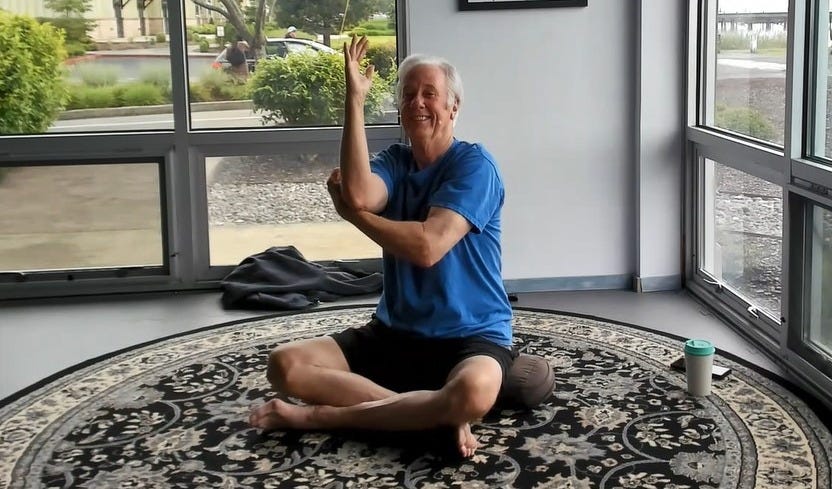
That’s what I call most of my classes.
Sometimes I throw Qigong into the name, but the foundation is pretty much the same.
Breathe. Move. Stretch.
It sounds like I sat down one day, figured out the three most important things for staying healthy, and built my classes around them.
Not even close.
Back in 2007, I was facing seven surgeries. I wasn’t particularly excited about that prospect, so I started looking for another way.
Resistance stretching was what changed things for me.
Muscles contracting while they’re being stretched. Strength and flexibility working together instead of being treated like separate projects.
That opened a door I didn’t even know existed.
Then breathing came later.
I’d heard yoga instructors talk about the breath, of course. And I practiced.
But it took time before I began to appreciate just how much difference breathing could make.
About twelve or thirteen years ago, I started practicing Tai Chi.
I loved the forms. There’s something beautiful about those movements. But I also found myself feeling restricted by them. I wanted more freedom to explore, to move differently, to follow what my body was telling me.
That’s how I found Qigong.
Over the years, I’ve studied with different Qigong masters, exploring their approaches to breathing, movement, and the relationship between the two.
And something clicked.
It felt like the final piece of what I’d been putting together all those years. Not something I’d planned. Just another discovery that turned out to be a big one.
These days, Qigong is how I start every morning.
I get out of bed, put the coffee on, and do a short Qigong practice while it’s brewing.
Nothing elaborate. Just breathing and moving.
I incorporate Qigong into almost every class I lead ... even chair and drum classes.
It’s become one of the most powerful parts of my practice, and I can’t imagine starting my day without it.
And then there’s movement.
You have to move.
I don’t care how wonderful your stretching routine is or how beautifully you breathe. If you spend the rest of your day sitting in a chair, you’re missing a pretty important part of the equation.
Get up. Walk around. Bend over. Reach for something. Get down on the floor once in a while.
And preferably figure out how to get back up.
Over the years, those three things gradually came together.
Not because I read about some magical three-part formula.
Because I lived it.
I’m 73 now. Still teaching classes, still moving, still learning things about my body that surprise me.
I give resistance stretching enormous credit for changing the direction my life was headed.
And I believe the breathing and movement practices I’ve added over the years have helped me keep going.
So when it came time to name my classes, I didn’t have to think very hard.
Breathe. Move. Stretch.
Pretty much what it says on the label.