
I ran across something interesting the other day.
Apparently, your pancreas has a bedtime.
Not that it crawls under the covers and pulls up a blanket. But it does seem to pay attention to whether it’s getting close to yours.
And that could make a difference in what happens when you eat dinner.
Most of us know about melatonin. It’s the hormone that helps signal to our bodies that nighttime is approaching.
What I didn’t know was that the cells in our pancreas responsible for producing insulin also have receptors for melatonin.
And when melatonin levels rise, insulin production can decrease.
Which raises an interesting question.
What happens if you eat the same food at different times of the evening?
Researchers decided to find out.
In a study involving 845 adults, participants were given the same glucose drink on two different occasions.
Once, about four hours before their usual bedtime.
And again, just one hour before bedtime.
Same people. Same amount of glucose. Different timing.
The results?
When participants consumed the glucose closer to bedtime, their blood sugar response was about 8% higher, while their insulin response was about 7% lower.
Their melatonin levels were also considerably higher.
And here’s another interesting wrinkle.
Researchers found that a common genetic variation affecting melatonin receptors made some people more sensitive to the timing difference than others.
So two people could eat the same thing at the same time and have somewhat different responses.
Now, before we all start setting alarms to remind ourselves when to eat dinner, there are a few things worth remembering.
This was a glucose test, not a plate of steak and vegetables.
And the researchers were measuring short-term changes in blood sugar and insulin, not whether eating late would eventually cause diabetes or shorten anyone’s life.
Still, I find the whole thing fascinating.
We’ve spent a lot of time talking about what we eat.
Protein. Carbohydrates. Fat. Calories.
And those things matter.
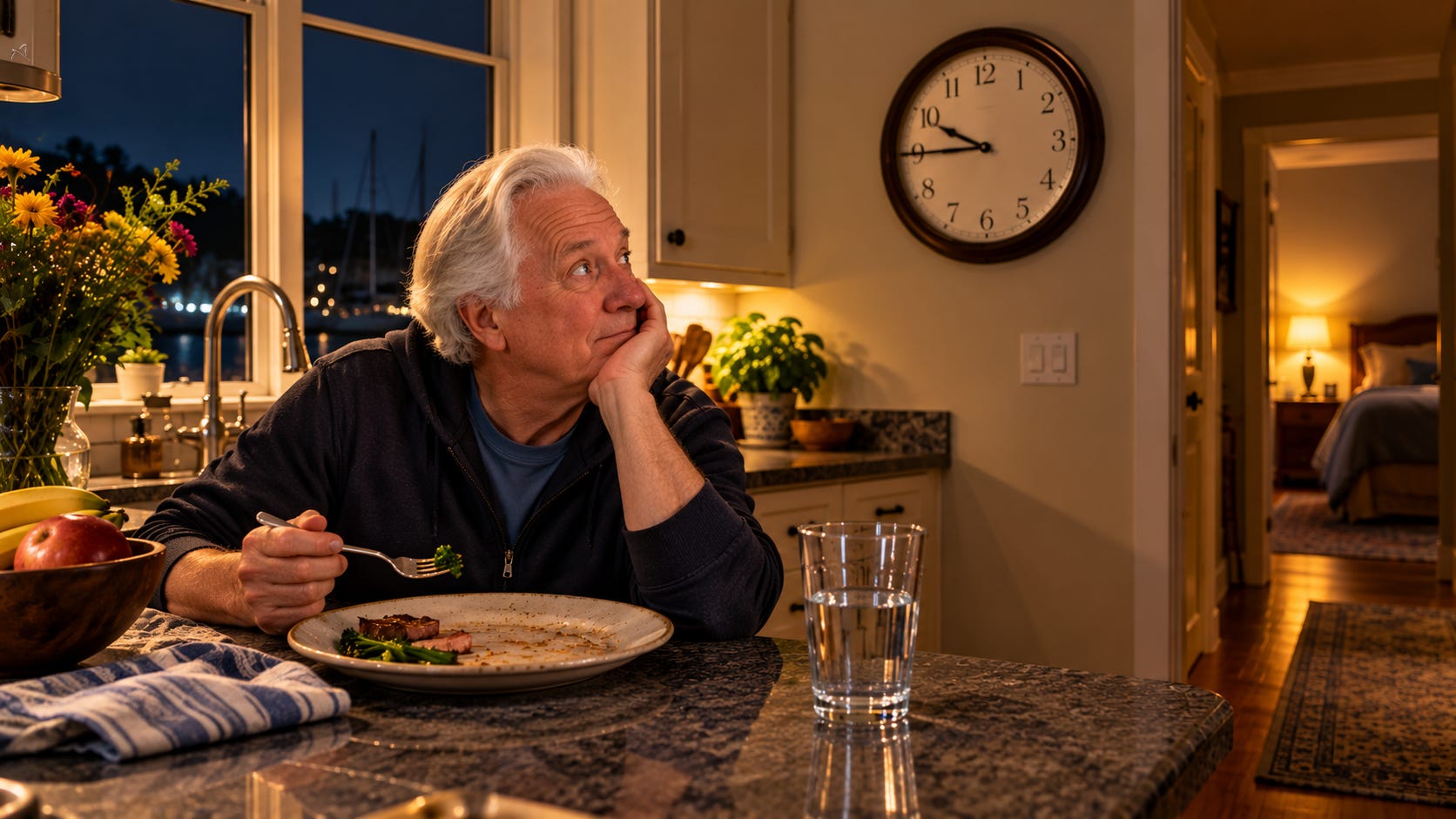
But apparently, the clock on the wall might have something to say about dinner, too.
I don’t know that this means everyone needs to eat earlier. People’s schedules, sleep patterns, and individual responses vary.
But it does give us another piece of information to consider.
And I have to admit, I rather like the idea that my pancreas has an opinion about when I should be eating.
Even if it hasn’t bothered to tell me directly.